• Welcomes to Kumbakonam City

    Kumbakonam is one of the oldest towns in Tamilnadu and is famous for its Mahamaham festival. In the 7th Century it was the Capital of Chola Kings. Kumbakonam, the famous temple town of South India, is picturesquely located amidst the two rivers, Cauvery and Arasalar. Read more
  • Shoping at kumbakonam

    Kumbakonam is a Special Grade Municipal Town and second biggest town in terms of administrative status in Thanjavur District. Kumbakonam, being the headquarters of Kumbakonam Taluk, had different names like Kudanthai, Kudamooku and Baskarashetram from time immemorial.. Read more
  • Kumbakonam Temples

    Kumbakonam is known for its temples and mathas (monasteries). There are around 188 Hindu temples within the municipal limits of Kumbakonam... Read more

Solar Panels


All you need to know about Solar Panels
Solar panels are now widely available all over the world. You will find many homes, commercial buildings and vehicles using mainly solar panels to generate the electricity they need. Solar panels can also be made independently by the user. You can save more by building your own system. You can also invest in a ready-made design for added ease and convenience. Here are some more tips and tricks on how to begin.
The Benefits
If you choose to use solar panels, you will be able to produce electricity that can power various applications. Off-grid living means residing in a location where the main electric utility grid does not service your home or office. There are remote cabins and homes that can benefit from solar power systems. It is no longer needed to pay huge bills to install electric utility posts and cabling from the nearest grid access main point. A solar electric system is less expensive and can give you power for up to 30 years if you maintain it well.
Solar power is also a renewable source of energy, which means that it is very clean. Today, it is more important to invest in devices that do not damage the environment and atmosphere. Solar panels do not have any moving parts and will need only minimal maintenance. As soon as the system has paid for its initial installation costs, you can get the benefits for several decades more for free.
Buying Solar Panels
There are plenty of places where you can buy the best solar panel models. You can choose between brands such as Sharp, BP Solar and General Electric. You should visit some of the manufacturer web sites to determine the process and the ways how their solar panels are built. You should also read about the background of the company and what their objectives are in making these pieces. You should read more about installation to check if you want to install or build the panels yourself or hire a professional.
There are several web sites, online forums and internet stores where you can learn more about the available models and how these can best suit your location. Some panels are intended for individuals living in places that has minimal sun, while other designs are specifically made to gather the most sun over the shortest span of time.
Price
Learn how to compare between types to know how much you need to pay for. The prices of the solar panels will vary depending on the brand and the size. There are also other factors to consider such as maintenance and if the package includes free installation. Some companies will ask for fees to install the panels, while other buyers may opt to install these themselves to save more. Talk to other people who have already tried certain makes and brands and let them give you the pros and cons of each. Ask for referrals and recommendations to ensure that you are only investing in the best places.

Solar Panel Diagram


                     The central part of a solar panel is a semiconductor diode, a two-layer electrical component that conducts current in one direction (and only one direction) from the bottom semi-conductor layer to the top semi-conductor layer. It’s a one way street. Both layers are made of a semi-conductor material, typically silicone with some added impurities to create a situation where an electrical field can form at the intersection between the two layers.
Solar Panel Diagram Cross Section
P-Type Silicon Layer

         The thicker bottom layer, referred to as the p-type layer, is doped (impurities added) with a small amount of something like boron, which gives the silicon layer a positive (p-type) character. This p-type characteristic means the molecular structure of boron-doped silicon naturally contains an extra hole (positive charge carriers). Freely floating electrons (negative charge carriers) that pass by are drawn in and fill this hole, and in doing so the electron releases its stored energy. The electron remains in this hole until they are energized and knocked free by some external force (like the introduction of photons). It’s kind of a transient home.


N-Type Silicon Layer

            The thinner top layer, referred to as the n-type layer, is doped with something like phosphorous, which gives the silicon layer a negative (n-type) character. This n-type characteristic means the molecular structure of phosphorous-doped silicon naturally contains an extra electron. This extra electron can be knocked free by some external force.

Solar Panel Diagram Layered View
P-N Junction

              Where the top (n-type) and bottom (p-type) doped-silicon layers meet is called the p-n junction. This is the boundary across which the electric current flows once energy in the form of photons (from sunlight) is introduced. As sunlight shines into the solar panel some photons are absorbed into the p-n junction, which energizes and knocks free some electrons from both silicon layers. This knocking free of electrons is the photovoltaic effect. The newly free and energized electrons from the top n-type silicon layer and the holes from the p-type silicon layer meet up at the p-n junction and the electrons essentially cross over from the top to the bottom. Don’t confuse the direction of the electrons with the direction of the current. They move in an opposite direction. The electrons move from top to bottom, yet the electrical current moves from the bottom to the top. The mass exodus of electrons jumping over the p-n junction creates a void in the top n-type silicon layer – the phosphorous-doped silicon molecules are sorely missing their extra electron, but they can’t pull it back across the p-n junction as that’s only a one-way street. They need to get it from somewhere else. In a complete functioning system, this bottom and top silicon layer are not only connected by the p-n junction, but also by a wire (a highly conductive material) going out of the bottom of the solar panel, over to the electrical application (where the energy from the system is captured), and then back into the top of the solar panel. It’s a loop, or a complete circuit. The newly freed and energized electrons from the bottom p-type silicon layer that didn’t find a hole to rest in are drawn down and out of the solar panel and around the circuit and eventually back into the top of the solar panel to serve as the extra electrons in the top layer of electron depleted phosphorous-doped silicon molecules.


Metallic Terminals

            On the top and bottom of these sandwiched layers of Silicon, a highly conductive metallic material of some kind is present. The electrical current flowing from the bottom p-type layer to the top n-type layer seeks the path of least resistance and naturally heads for highly conductive metal terminal on the top of the solar panel and follows the attached wires out.


Wiring

        The wires go from the solar panel and attach to some sort of electrical application (a battery bank where the energy is stored, or directly connects to an electrical appliance) and then other wires come back and attach to the metallic terminal on the bottom of the solar panel, forming a self-contained circuit of flowing electrical current in one direction and flow of electrons in the other direction. Newly energized (by photons in the sunlight) electrons flow thru this circuit out of the bottom of the solar panel (the p-type side), out to the electrical application (where they give up their energy), and then return as un-energized electrons thru the top metallic terminal and back into the top n-type silicon layer and recombine at the molecular level with the silicon (essentially replacing other electrons that were energized and knocked free by the photons and crossed over the p-n junction). The cycle repeats so long as photons (energy) are being introduced into the system (as long as the sun is shining). There are no moving parts to this system and no physical material is consumed or emitted.


Protective Coating

               The solar panel is typically encased by some form of glass to protect it from the environment.


Anti-reflective Coating

           The object is to capture as much sunlight (and photons) as possible, so an anti-reflective coating is applied under the glass to minimize the reflective properties of the solar panel materials.


SOLAR THERMAL PANELS TO PRODUCE HOT WATER


                   Solar thermal panels are a way of generating hot water from the energy from the sun all year round and even on cloudy days albeit to a lesser extent. It is the most environmentally friendly method of generating hot water, available to almost everyone.
Solar energy is fast becoming the most important energy source for humanity as non-renewable resources such as coal, gas and oil dwindle to nothing. So how does this affordable and green technology work in your home?
How the Solar PV system work
  • Energy from the Sun is ‘harvested’ by the solar thermal panels, either by evacuated tubes or flat plate collectors. The solar energy heats the liquid in the solar thermal panels.
  • The hot liquid from the solar panels is fed into the coil inside the hot water cylinder to heat the water for the home for free.
  • The existing heating system is usually retained to supplement the hot water produced by the solar thermal panels.
  • Most conventional boiler and hot water cylinder systems are suitable for use with solar thermal panel systems but some, such as combination boilers are not.
  • For most properties, the solar thermal panel systems are effective for providing hot water for use in the home, but are not usually large enough to provide hot water for central heating (particularly since central heating is usually required in the winter months when the system is at its least productive).

WHAT ARE SOLAR THERMAL PANELS?

              Solar thermal panels convert solar energy from sunlight into heat energy to provide free hot water to the property. Two types of solar thermal panels are available -
Flat-plate collectors consist of an insulated metal frame with glass on the top and a copper or aluminium absorber plate on the bottom, which is coated with a special dark coating to absorb the sun’s energy.
Sunlight passes through the glass on the top and the sunlight energy is absorbed by and heats up the bottom absorber plate. Fixed to the absorber plate are tubes containing transfer liquid and through thermal conductance the heat from the absorber plate is transferred into the liquid.
Evacuated heat pipe tubes (EHPTs) consist of a number of evacuated glass tubes each of which contains an absorber plate that is fused to a heat pipe. The solar energy is collected in much the same way as a flat-plate collector and is transferred to the transfer liquid. The EHPT panel is contained within an insulated frame. The vacuum surrounding the outside of the heat pipe significantly reduces convection and conduction heat losses to the surrounding air.

Evacuated heat pipe tubes tend to be more efficient than flat-plate collectors, particularly in colder climates.

           Please see our What we Supply section for a detailed look at solar thermal system components we sell and install.

HOW WE INSTALL THE SOLAR THERMAL SYSTEM

               Other than the largest jobs, the great majority of projects take 1 day to install. Please see our Installation section for a step by step guide on how we install these systems reliably and safely.

WILL SOLAR THERMAL SYSTEMS WORK IN MY HOME?

                     Solar thermal panels rely on exposure to solar energy and the more solar energy that is available, the better the system works. Solar thermal panels can be installed on almost any building, whether you are in an urban or rural location. Please see our Is it right for me? section to confirm that your property is suitable.

WILL MY SOLAR THERMAL PANELS WORK WHEN IT’S CLOUDY?

                  Solar thermal panels operate on solar energy, rather than heat, so even if the day seems cool – if there is light, the system will be converting some solar energy into heat. Solar thermal systems will therefore generate heat all year round, but the greatest benefit will be during the summer months.

RELIABILITY OF SOLAR THERMAL SYSTEMS

               The reliability of solar thermal systems has been established through use over many years. Because there are no moving parts, the systems tend to be very reliable and require little maintenance.

HOW DO I GET A SOLAR THERMAL SYSTEM INSTALLED?

               Call or email us, every customer is very important to us, so we'll get back to you as quickly as we can.

22.5 kW Mansfield, OH Commercial Solar Installation


22.5 kW ground mounted solar array located in a lovely park in Mansfield, Ohio. Ohio is a state gaining momentum in solar so it is great to see installs like this popping up all over the state.

22.5 kW Mansfield, OH Light Commercial Solar Installation22.5 kW Mansfield, OH Light Commercial Solar Installation
Location
Mansfield, OH 44902
United States
Date Installed11/2012
Total Size22.50 kW
Profile visibilityPublic
22.5 kW ground mounted solar array loacted in a lovely park in Mansfield, Ohio, featuring the Astronergy 250 W module, with the power inverted by Fronius' new IG Plus V line of inverters. Ohio is a state gaining momentum in solar so it is great to see installs like this popping up all over the state.

24 kW New Virginia, IA Ground Mount Solar Project

24 kW ground mounted solar installation on a wide open ranch in New Virginia, Iowa.
24 kW New Virginia, IA Ground Mount Solar Project24 kW New Virginia, IA Ground Mount Solar Project24 kW New Virginia, IA Ground Mount Solar Project24 kW New Virginia, IA Ground Mount Solar Project

Location
New Virginia, IA 50210
United States
Date Installed12/2012
Total Size24.00 kW

24 kW ground mounted solar installation on a wide open ranch in New Virginia, Iowa. In addition to using Canadian Solar 250W monocrystalline modules, and industry favorite Enphase m215's, this install also features a cool, custom, self built ground mount system.

Renewable Purchase Obligation (RPO) compels state government to promote solar power generation

            Gujarat accounts for close to 58 per cent of the country's total solar power output of 1190 MW, followed by Rajasthan with nearly 17 per cent. Rest are way behind. But thanks to Renewable Purchase Obligation(RPO) targets specified by state electricity regulatory commissions, state governments are coming out with schemes to promote solar power generation in a big way. ET track their progress:

Advantages/Disadvantages


Advantages
              Solar cells are long lasting sources of energy which can be used almost anywhere. They are particularly useful where there is no national grid and also where there are no people such as remote site water pumping or in space.
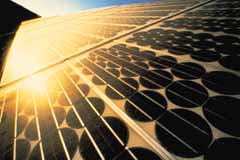
Image taken from www.bigfrogmountain.com without permission
               Solar cells provide cost effective solutions to energy problems in places where there is no mains electricity. Solar cells are also totally silent and non-polluting. As they have no moving parts they require little maintenance and have a long lifetime. Compared to other renewable sources they also possess many advantages; wind and water power rely on turbines which are noisy, expensive and liable to breaking down.
Rooftop power is a good way of supplying energy to a growing community. More cells can be added to homes and businesses as the community grows so that energy generation is in line with demand. Many large scale systems currently end up over generating to ensure that everyone has enough. Solar cells can also be installed in a distributed fashion, i.e. they don't need large scale installations. Solar cells can easily be installed on roofs which means no new space is needed and each user can quietly generate their own energy.

Disadvantages
                 The main disadvantage of solar energy is the initial cost. Most types of solar cell require large areas of land to achieve average efficiency. Air pollution and weather can also have a large effect on the efficiency of the cells. The silicon used is also very expensive and the problem of nocturnal down times means solar cells can only ever generate during the daytime. Solar energy is currently thought to cost about twice as much as traditional sources (coal, oil etc). Obviously, as fossil fuel reserves become depleted, their cost will rise until a point is reached where solar cells become an economically viable source of energy. When this occurs, massive investment will be able to further increase their efficiency and lower their cost.

Uses of solar cells


Space
              Solar cells are very useful in powering space vehicles such as satellites and telescopes (e.g. Hubble). They provide a very economical and reliable way of powering objects which would otherwise need expensive and cumbersome fuel sources.
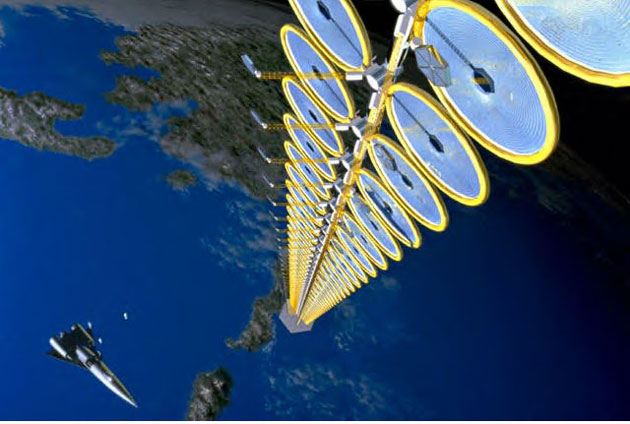
Image taken from www.space.com without permission
The above design for a solar cell array in space features many inflatable, fresnel reflectors which focus the Sun's light on small arrays of high efficiency cells.
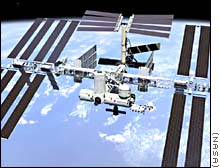
The international space station is also another good example of solar cells being used in space. When it is finished, the station will have the most powerful solar array in space. Four sets of gold coloured wings (each one being 72 metres long and larger than the space station itself) will contain 250,000 solar cells and the whole array will be able to power a small neighbourhood. Some of the energy will be used immediately, such as in life support machines while some will be stored in batteries for when the station is not in use.
Image taken from www.cnn.com without permission
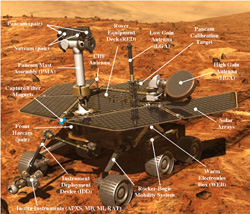
Solar cells are also being used to power the rovers which will be examining the surface of Mars in early 2004.
Image taken from: http://mars.jpl.nasa.gov/ without permission

Solar powered vehicles
Solar powered cars are cars which are powered by an array of photovoltaic cells. The electricity created by the solar cells either directly powers the vehicle through a motor, or goes into a storage battery. Even if a vehicle is completely covered in solar cells, it will only receive a smaller amount of solar energy and will be able to convert only a small amount of that to useful energy. Because of this, most solar powered vehicles are only used in research, educational tools or to compete in the various races for solar powered vehicles.
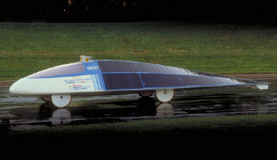
The first solar powered car was built be Ed Passerini in 1977. Many large motor manufacturers have also put some serious research into solar cars. General Motors, for example, spent $8 million developing the "Sunraycer" (below). This car has a 90 square foot solar array incorporated into it's teardrop shaped body. Despite being 6m long, the total weight of the car is only 177kg due to light weight composites used in it's manufacture. 
Image taken from www.gm.com without permission
Many races for solar powered vehicles occur throughout the year and serve to develop new technologies and show the public the idea of solar power as a viable power source. One of the first and most famous races is the World Solar Challenge; a 1872 mile race held in Australia. In 1996 Honda won with an average speed of 55.77mph. However, these kinds of average speeds can only be obtained with good weather conditions and huge investment in the vehicle. Production solar vehicles are still in their infancy and lots more research and development needs to be done before they can get close to the production line.

In India, home solar energy on a pay-as-you-go plan


Simpa Networks is a venture-backed technology company aiming “to make modern energy simple, affordable, and accessible for everyone,” in the company’s own words. Toward that end, it sells distributed energy solutions on a “progressive purchase” basis; customers make a small initial down payment for a high-quality solar photovoltaic system and then pre-pay for the service, topping up their systems in small user-defined increments using a mobile phone. Powered by the Simpa Regulator — a tamper-proof, system-integrated microcontroller and user interface — and cloud-based software, the system ensures that once prepaid consumption is exhausted, the solar home system is temporarily disabled until another payment is made. Each payment, meanwhile, also counts towards the final purchase price. Once fully paid, the system produces clean energy, free and clear for the rest of the system’s expected 10-year useful life.
Now available for customers in Karnataka, India, Simpa Networks’ model is built upon proprietary risk mitigation technology, with investment opportunities for market rate and social investors, it says. Time to help expand clean energy access around the globe?

SOLAR PHOTOVOLTAICS FOR YOUR HOME


                    Photovoltaics (PV) is a way of generating electricity from sunlight all year round and even on cloudy days. It is the most environmentally friendly method of generating power, available to almost everyone. Photovoltaics have been successfully used to power satellites in space for 50 years, and is used in everyday items such as roadside signs, calculators and clocks.
In the near future, solar energy will be the most important energy source for humanity as non-renewable resources such as coal, gas and oil dwindle to nothing. So how does this affordable and green technology work in your home?

How the Solar PV system work
  • Light from the Sun is ‘harvested’ by the photovoltaic panels, which convert the solar energy into electricity
  • The electricity from the panels is collected in series and fed to the inverter where it is converted to alternating current, suitable for your home
  • This power is then used by the householder for free and....
  • Any excess power generated is fed back into the national grid through a meter, and the householder receives payment
  • Regardless of the power fed into the main grid, the householder receives a feed-in tariff as a quarterly payment related to the nominal power of the system

WHAT ARE PHOTOVOLTAIC CELLS?

           Photovoltaics is the conversion of sunlight into electricity using a physical reaction benefitting from the natural properties of silicon, which is a semiconductor. In their manufactured form, the silicon solar cells individually produce electricity. These cells are grouped together in panels, which are then linked to deliver the electricity.
Silicon is the earth’s second most common element and can be easily extracted from the earth’s crust in vast quantities. Each solar cell is made up of a negatively charged layer and a positively charged layer, and when sunlight falls on the solar cell, the natural physical reaction generates direct current (DC).

HOW THE ELECTRICITY IS USED IN YOUR HOME

             For general use, this direct current (DC) needs to be converted to alternating current (AC), this is done and controlled by a device called an inverter. Having been converted to AC, the electricity generated is automatically used to power your house (lights, television, appliances, etc). All you have to do is sit back and enjoy the benefits, it couldn’t be simpler!
The main purpose of the inverter is to convert the DC to AC but it also has other important functions and features. The controls within the inverter include maximum power point (MPP) tracking to ensure maximum output from the solar panels, even in low light conditions. It starts up at the beginning of the day requiring only 5-10 watts and then continues monitoring and controlling until the end of the day. There are numerous safety features including automatic cutout of feed into the national grid if the supplier’s grid goes down (to prevent any possibility of injury to the supplier’s engineers working to repair the fault). Associated with the inverter are advanced monitoring and reporting features.

HOW TO EXPORT THE EXCESS ELECTRICITY YOU DON’T USE

           The system will include a total generation meter (OFGEM approved) and an export meter to control and record the electricity that you feed back in to the national grid and for which you will be paid (for details refer to the Benefits page). We include the cost of the supply and installation of the export meter in our quotation, some of our competitors do not.
There are various ways that the system can be set up to control how much electricity you take from the system for free and how much is fed back into the national grid. The best set up for you will depend on your pattern of usage. If you are in the house all day as opposed to only being there in the mornings and evenings, the benefits of free electricity to you can be much greater. We will discuss your usage and provide you with the best possible set up to get the most from your system.

WHAT DOES A PHOTOVOLTAIC SOLAR PANEL SYSTEM CONSIST OF?

The following components:-
  • PV panels for generating electricity from light (mounted on aluminium framing)
  • Inverter for converting DC into AC and to control the entire system
  • Total generation meter for monitoring the instantaneous and total power produced by the system.
  • AC export meter for recording the electricity delivered to the national grid.
  • DC and AC isolation switches
  • Cables and couplings
  • Warning labels
Please see our What we Supply section for a detailed look at PV System components we sell and install.

HOW WE INSTALL THE PV SOLAR PANEL SYSTEM

         Other than the largest jobs, the great majority of projects take 1 day to install. Please see our Installation section for a step by step guide on how we install these systems reliably and safely.

WILL PHOTOVOLTAICS WORK IN MY HOME?

        Solar panels rely on exposure to light from the sun and the more light that is available, the better the system works. Solar PV panels can be installed on almost any building, whether you are in an urban or rural location. Please see our Is it right for me? section to confirm that your roof is suitable.

WILL MY PV PANELS WORK WHEN IT’S CLOUDY?

           Solar PV operates on light, rather than heat, so even if the day seems cool – if there is light, the system will be generating electricity. PV systems will therefore generate electricity all year round.
Nevertheless, the output will fluctuate seasonally, with the most electricity being produced in the bright summer months. Shaded locations that never benefit from full sunlight are not suitable.

RELIABILITY OF PV SYSTEMS

                  The reliability of PV systems has been established through use over many years. Sharp PV modules have been used for decades to power satellites in space. Sharp PV modules have been installed in over 1,000 lighthouses, providing proof that they continue to operate, even in extreme conditions.
Photovoltaic products are being developed and refined at a rapid pace with continual improvements in performance. Eco Warriors Solar and their supply partners continually monitor the manufacturing supply chain to take advantage of new developments.
Please see our What we Supply section for a detailed look at the Sharp PV System components we install.

HOW DO I GET A PV SYSTEM INSTALLED?

          Call us, email us, or complete the form in the Get a quote section. Every customer is very important to us, so we'll get back to you as quickly as we can.