• Welcomes to Kumbakonam City

    Kumbakonam is one of the oldest towns in Tamilnadu and is famous for its Mahamaham festival. In the 7th Century it was the Capital of Chola Kings. Kumbakonam, the famous temple town of South India, is picturesquely located amidst the two rivers, Cauvery and Arasalar. Read more
  • Shoping at kumbakonam

    Kumbakonam is a Special Grade Municipal Town and second biggest town in terms of administrative status in Thanjavur District. Kumbakonam, being the headquarters of Kumbakonam Taluk, had different names like Kudanthai, Kudamooku and Baskarashetram from time immemorial.. Read more
  • Kumbakonam Temples

    Kumbakonam is known for its temples and mathas (monasteries). There are around 188 Hindu temples within the municipal limits of Kumbakonam... Read more
Showing posts with label techno. Show all posts

Solar rooftops to generate power in 120 police stations

CHANDIGARH: The Punjab Government has initiated an ambitious program to install rooftop photovoltaic solar systems in 120 police stations in the state for power generation.  

Bikram Singh Majithia, Non Conventional Energy Minister, today said that Punjab Energy Development Authority would soon embark on a major programme for these installations in order to increase usage and popularize Solar PV technology for power generation. 

He said that these solar PV systems would be installed in all 120 police stations in the state and each system would generate 2.5 KW power for powering lighting and computer loads in the police stations. He said that the total cost of this project was Rs 6.6 crore.

Reiterating the resolve of Punjab Government to install Solar Power Systems on all government buildings by the end of 2017, Majithia said that the power generated through these rooftop systems would replace conventional energy and also provide backup power during grid shut downs. 

He said that PEDA was already promoting the installation of rooftop PV Power Plants in which capital subsidy was being provided as per the guidelines of Ministry of New and Renewable Energy guidelines, GOI. He said that these projects would also reduce generation cost, which was in the range of Rs. 6-7/Kilowatt hour in the long term and which was also almost comparable to the tariff being charged by the PSPCL from its consumers.

Divulging the details of rooftop solar power systems, Majithia said that PEDA has also carried out a detailed rooftop survey of major Government Buildings in the State and estimated potential was 40 MW. He said that solar power generated from the rooftops would also replace conventional power and provide backup power to buildings during grid outage including surplus power being exported to the PSPCL grid.

How heat affects photovoltaics


Hoe%20heat%20affects%20PV.jpg
There’s a complex relationship at work between photovoltaics (PV), heat and sunlight. Solar power works best when the sun’s shining (of course). But when the sun’s shining, everything gets hotter.

PV semiconductors offer more resistance in extreme heat, making them less efficient when the modules should be most efficient. Thankfully, this additional resistance is small, at most, reducing efficiency by about 10 percent. But newer technologies—likethin-film PVs, which don’t rely on crystalline silicon to produce electricity—are less susceptible to heat-related efficiency losses.
So despite PV panels being best suited for regions like the southwestern United States, which receive upwards of 6.0 kilowatt hours of sun per square meter daily, PV panels actually function better at colder temperatures, particularly crystalline silicon-based cells, which are the most commonly used. Their thin-film counterparts suffer smaller efficiency losses due to high temperatures. In an arid region like the southwest, most of today’s PV cells aren’t operating at their peak efficiency during the hottest days of the year.
The semiconducting materials used in PVs, particularly in crystalline silicon PV cells, lose efficiency as temperatures increase. The Physics Hypertextbook explained that as temperature in a conducting material increases, quasiparticles, called phonons, are excited and move throughout the material, impeding the uniform movement of electrons. This impedance is what reduces efficiency in PVs when it gets too hot.
Newer technologies like thin-film PV use different semiconductor materials like Copper indium gallium selenide (CIGS), which don’t lose as much efficiency in the heat. In fact, a study by Loughborough University, “Mapping the Performance of PV Modules of Different Types” found that CIGS produced between 0.5 percent to 2.5 percent more power over a year period, “with the largest differences found in hotter climates.” Another form of thin-film PV, using Cadmium Telluride as the semiconducting element to produce electricity, performed better than crystalline or CIGS PV cells did in high temperatures. The study said that “The performance of CdTe is consistently higher than the two other technologies, by a margin of 5-12 percent over c-Si, depending on location.”
However, some new nanophotovoltaics actually capture infrared (heat) radiation from the sun and would feasibly, when they make it to market, operate at higher efficiencies in the heat. Until then, we’re stuck with thin-film PV and silicon PV modules that operate at lower efficiency in higher temperatures.

What is a Kilowatt Hour?


b_250_250_16777215_00_images_g_kilowatthours_250_250.jpg
What is a kilowatt hour?

Different types of energy are measured by different physical units: Barrels or gallons for petroleum, Cubic feet for natural gas, Tons for coal, and Kilowatt-hours for electricity
A kilowatt is a unit of power equal to 1000 watts. Wikpedia defines a watt as a “derived unit of power in the International System of units (SI), named after the 18th century Scottish engineer James Watt.  The unit symbol for a watt is “W” and the unit symbol for a kilowatt is “kW”.
A kilowatt hour is the amount of energy you get from one kilowatt for one hour. Electricity use over time is measured in kilowatt hours . Your electric company measures how much electricity you use in kilowatt hours, abbreviated “kWh”. An example of what one kilowatt-hour can do is: 1200 electric shaves, dry your hair 15 times, 4 TV evenings, use a small refrigerator for 24 hours or 4 evenings of light with 60W incandescent lamps. This according to TreeHugger.com
How many kilowatts does an average U.S.home use?
According to the U.S. Energy Information Administration, in 2008, the average annual electricity consumption for a U.S. residential utility customer was 11,040 kWh, an average of 920 kilowatt hours per month.  Tennessee had the highest annual consumption at 15,624 kWh and Maine the lowest at 6,252 kWh.

Report: 180 Solar Panel Makers Will Disappear By 2015


A huge bumper crop of solar panels already has caused a sharp decline in their prices and bankrupted many manufacturers worldwide over the past two years. Now a research report released Tuesday says another 180 solar panel makers will likely go out of business or be bought by 2015.
Nearly half of them – or 88 companies – will shut down factories in countries that have become too expensive for producing solar panels, namely the United States, Europe and Canada, said GTM Research. The report looks at over 300 solar panel makers to determine their chances of survival.
The prognosis is not only shocking, but it also answers a perennial question, at least for now, about whether solar manufacturing can thrive in the United States. China, which has used state owned banks and utilities to finance solar factory expansion and create domestic demand for solar panels, will continue to dominate solar manufacturing, though the government is reportedly working on rescuing only 12 large companies and forcing mergers in others. GTM is estimating that 54 solar panel makers in China will not survive over the  next three years.4
“Given where the industry is right now and how committed China is for its solar manufacturing industry, it’s very difficult for the U.S. to compete,” said Shyam Mehta, the senior analyst who authored the GTM report. In fact, by the end of 2013, cell and panel manufacturing could disappear all together in the United States.
China’s rise as the world’s epicenter for solar manufacturing has elicited resentment from rivals who believe Chinese companies haven’t competed fairly. The U.S. Department of Commerce recently sided with petitioners of such a trade complaint and imposed tariffs after finding that Chinese solar companies have indeed received illegal government subsidies and sold solar panels at below cost.
Signs of trouble began to show in early 2011, when changes in solar incentive policies in key European markets prompted solar panel makers’ customers – distributors and project developers – to delay purchasing decisions. Prices for solar panels began to fall faster than what manufacturers had expected. The prices dropped by about 50 percent last year and have continued to decline this year. At the same time, many manufacturers had built up massive factories and were counting on a huge surge in demand in the global market. In fact, they continued to churn out solar panels to keep their factories running and workers employed even though demand wasn’t keep pace.
First Solar, an industry bellwether, saw flat revenues and lower earnings during the first quarter of 2011. Life pretty much went downhill from there for many solar panel makers and their suppliers. Young companies that were entering mass production of their technologies in order to compete effectively with larger rivals went bust, including Solyndra and Abound Solar. GE, which once embarked on an ambitious plan to build a 400-megawatt factory in Colorado, decided to shelve that project earlier this year. First Solar, long the king of low-cost manufacturing, decided to gradually shut down its big factory in Germany and put on hold its plans to build new factories in Vietnam and Arizona. Other solar panel makers in the U.S., Europe and Asia have made similar decisions to shutter factories or file bankruptcy.
SunPower is one of them. The San Jose company announced Tuesday it will suspend production at six of the 12 solar cell production lines and cut solar panel production by 20%  in the Philippines. It plans to lay off about 900 employees, most of them located in the Philippines.
Still, some solar manufacturers have proceeded with their plans to build new factories for a variety of reasons. Some thought the oversupply problem would be over soon; others needed to scale up their production to cut costs. As a result, the world will likely see 35 gigawatts of excess solar panels for sale per year over the three years, GTM said.
The plummeting prices for solar panels are good news for installers and solar power plant developers – and ultimately consumers. Some developers haveswitched to solar panels instead using other types of solar technologies. An increasing number of manufacturers have entered the business of developing solar energy generation projects since they are not  making money selling solar panels.

Components of A Residential Solar Electric System


b_252_252_16777215_00_images_g_iStock_000008207070XSmall.jpg
A complete home solar electric system requires components to produce electricity, convert power into alternating current that can be used by home appliances, store excess electricity and maintain safety.

Solar Panels
Solar panels are the most noticeable component of a residential solar electric system. The solar panels are installed outside the home, typically on the roof and convert sunlight into electricity.
The photovoltaic effect is the process of converting sunlight into electricity. This process gives solar panels their alternate name, PV panels.
Solar panels are given output ratings in watts. This rating is the maximum produced by the panel under ideal conditions. Output per panel is between 10 and 300 watts, with 100 watts be a common configuration.
Solar Array Mounting Racks
Solar panels are joined into arrays and commonly mounted in one of three ways: on roofs; on poles in free standing arrays; or directly on the ground.
Roof mounted systems are the most common and may be required by zoning ordinances. This approach is aesthetic and efficient. The main drawback of roof mounting is maintenance. For high roofs, clearing snow or repairing the systems can be an issue. Panels do not usually require much maintenance, however.
Free standing, pole mounted arrays can be set at height that makes maintenance easy. The advantage of easy maintenance must be weighed against the additional space required for the arrays.
Ground systems are low and simple, but cannot be used in areas with regular accumulations of snow. Space is also a consideration with these array mounts.
Regardless of where you mount the arrays, mounts are either fixed or tracking. Fixed mounts are preset for height and angle and do not move. Since the angle of the sun changes throughout the year, the height and angle of fixed mount arrays are a compromise that trades optimum angle for a less expensive, less complex installation.
Tracking arrays move with the sun. Tracking array move east to west with the sun and adjust their angle to maintain the optimum as the sun moves.
Array DC Disconnect
The Array DC disconnect is used to disconnect the solar arrays from the home for maintenance. It is called a DC disconnect because the solar arrays produce DC (direct current) power.
Inverter
Solar panels and batteries produce DC (direct current) power. Standard home appliances use AC (alternating current). An inverter converts the DC power produced by the solar panels and batteries to the AC power required by appliances.
Battery Pack
Solar power systems produce electricity during the daytime, when the sun is shining. Your home demands electricity at night and on cloudy days – when the sun isn’t shining. To offset this mismatch, batteries can be added to the system.
Power Meter, Utility Meter, Kilowatt Meter
For systems that maintain a tie to the utility grid, the power meter measures the amount of power used from the grid. In systems designed to sell power the utility, the power meter also measures the amount of power the solar system sends to the grid.
Backup Generator
For systems that are not tied to the utility grid, a backup generator is used to provide power during periods of low system output due to poor weather or high household demand. Homeowners concerned with the environmental impact of generators can install a generator that runs on alternative fuel such as biodiesel, rather than gasoline.
Breaker Panel, AC Panel, Circuit Breaker Panel
The breaker panel is where the power source is joined to the electrical circuits in your home.  A circuit is a continuous route of connected wire that joins together outlets and lights in the electric system.
For each circuit there is a circuit breaker. Circuit breakers prevent the appliances on a circuit from drawing too much electricity and causing a fire hazard. When the appliances on a circuit demand too much electricity, the circuit breaker will switch off or trip, interrupting the flow of electricity.
Charge Controller
The charge controller – also known as charge regulator – maintains the proper charging voltage for system batteries.
Batteries can be overcharged, if fed continuous voltage. The charge controller regulates the voltage, preventing overcharging and allowing charging when required. Not all systems have batteries: 

Mosaic makes new friends as it expands crowdsourcing in 2013


Mosaic's ARC cityscape project
With some early and significant successes in 2013 Mosaic, a crowd funding solar project developer is forging ahead with new partnerships to expand its reach. Already the company sold its first three crowd funded projects in 2013, selling out $300,000 in under 24 hours. Now it's made some big new friends, among them Standard & Poor's and DuPont.

The companies partnered with Mosaic as part of the new truSolar working group. The collaborative effort with launched with 16 companies in the industry at are working to standardize risk assessment and develop a rating system to evaluate potential projects for their credit worthiness. "The truSolar Working Group was established on January 14th," said Mosaic spokesperson Lisa Curtis. "The founding members of truSolar, led by Distributed Sun and DuPont Photovoltaic Solutions, are among the leaders in solar project asset management, development, financing, manufacturing, insurance and ratings agencies. Founding member companies include Mosaic, ABB, Assurant, Inc., PanelClaw, SMA America, Standard & Poor’s, Booz Allen Hamilton, Rocky Mountain Institute and U.S. National Labs NREL and Sandia," she added.
The working group can help open the door to more potential project lenders. "Less than 5 percent of the country’s 6,500 banks and lending institutions are actively involved in financing solar projects due to ongoing concerns about, and misunderstanding, industry risks,” Curtis said. “Despite a robust market for solar installations, lenders struggle to efficiently underwrite loans in this field. In response to this problem, members of the truSolar Working Group are convening to develop uniform standards for solar project screening, rating and underwriting. These standards will reduce and reliably price financing risk, lower the cost of capital and broadly increase the availability of commercial lending for solar projects, helping market participants more accurately forecast asset performance throughout the lifespan of a solar project."
The partnership comes at an ideal time for the company, following the rapid closing of its first offerings to the public. “Selling out ourfirst publicly available investments in less than 24 hours has greatly raised our brand awareness and will hopefully lead to more partnerships with world-class leaders in energy and finance,” Curtis said.
The company plans to announce new projects soon, as well. “Our next round of projects will have a few options outside of California. Our focus is on finding high-quality solar projects to offer to our investors, the location is less important,” Curtis said.
At this point Mosaic is capable of providing financing for projects up to $2 million, according to Curtis. It’s fixed interest rates vary from 5.5 percent to 7.5 percent. As investors understand the lowered risk of solar projects those interest could go down somewhat.

Selling Residential Solar Power to Your Utility Company


Read more...
One benefit of a residential solar power system is the ability to offset your electric costs by selling excess power back to your local utility company.

Home solar electric systems produce power continuously during the hours of direct sunlight. Frequently, the power produced during these hours is more than the power consumed by the home during the same time period.
Electricity is volatile: you must use it immediately or store it in a battery or it is lost forever. Systems equipped with batteries have maintenance costs and disposal issues. In addition, storing electricity in batteries results in some loss, since batteries are not 100% efficient.
Selling the excess power to your utility can be a favorable alternative to storage, depending on how much your utility pays for the electricity it buys. Your state laws will determine the rate your utility must pay and not all states allow it. Usually, your utility will not be required to pay as much as a consumer pays for electricity.
When your residential solar power system is configured to sell power to the electric company, a two-way meter is installed to measure the amount of current flowing from your residential solar system back to the utility’s electric grid. The term “electric grid” refers to the wires and infrastructure used to generate and deliver power from a utility company.
The practice of selling power to your utility company is known as net metering. The term “net metering” is used because the amount sold is the difference, or net, between the metered usage of the home and the metered current flowing back into the grid.
There are strict codes that apply when you connect your residential power systems to the utility’s electric grid. A professional solar power installer from your area can design and install your system so it is in compliance with local codes, ensuring that you are eligible fornet metering.

3 Types of Residential Solar Electric Power Systems


There are three main types of residential solar electric power systems: grid inter-tied; grid inter-tied with battery backup; and off-grid. These three broad types vary in how closely connected they are to the traditional power utility infrastructure, known as the grid. Each type has strengths that determine how suited they are to your needs.

Grid Inter-Tied Residential Solar Power Systems

A grid inter-tied solar power system is directly connected to the home and to the traditional electric utility grid. Grid inter-tied systems allow the homeowners to get power from either the home electric system or the utility grid. Switching between the residential system and the grid is seamless.
The prime advantage of this type of system is the ability to balance the system production and home power requirements. When a grid inter-tied system is producing more power than the home is consuming, the excess can be sold back to the utility in a practice known asnet metering. When the system is not producing sufficient power, the home can draw power from the utility grid.
Grid inter-tied systems are the lowest cost type of residential solar electric system, due to having fewer required components.

Grid Inter-tied Residential Solar Power System with Battery Backup

A grid inter-tied solar power system is also connected to the traditional utility power grid and adds battery-backup to the system. The addition of a battery backup enables the system to balance production and demand and protects against power outages.
Solar electric system production depends on the available sunlight. When sunlight is abundant, production can exceed demand. When production exceeds demand, the excess power can charge the batteries, which store the electricity. When the system is producing less electricity than demanded by the home, the batteries can make up the shortfall.
Grid Inter-tied systems are also connected to the utility power grid. This enables the homeowners to draw from the grid during periods of excess demand and to sell power to the grid when there is excess production.
While grid inter-tied systems offer more flexibility, they are not without disadvantages. Charging and discharging batteries reduces the overall efficiency of the system and these systems are more complex to design and install and therefore more expensive.

Off Grid Solar Power Systems

An off-grid residential system is completely disconnected from the traditional electric power grid. Without a connection to the utility grid, batteries are essential to balance periods of excess production and excess demand.
To protect against shortfalls of power when the solar system is under-producing and the batteries are discharged, an electric generator is usually added to the system. The generator is used as a power source during periods of prolonged excess production or unusual demand.

All Systems

Within each type of system there are subtle variations in design that effect efficiency and convenience. To determine which system is best for you, review your requirements with a solar installation professional. A professional installer can guide you through the detailed choices of specific systems that best match your needs.

Andhra Pradesh Solar 1000 MW Pre-bid Meeting – Excerpts from Dec 14 Meeting at Hyderabad


Venugopal from EAI consulting team was at the pre-bid meeting that took place last Friday (Dec 14) and the following are what he has to say (this is in regard to the AP solar policy for 1000 MW power purchase that was released recently)
Highlights
1. Lack of clarity – Overall, the policy makers do not appear to have done their homework fully; as a result, there were quite a few questions to which answers were not available or were vague
2.  No payment security mechanism. AP is not TN, but people plonking in 100s of crores are going to expect something more than the utility’s good intentions alone when it comes to payment
3. Benchmark costs – Benchmark costs to be announced AFTER bidding process unlike other states’ policies. CERC CUF will be used as reference. Might not hold good for this state. (I read somewhere that AP is looking at price in the range Rs 6.5-7.5; is this an official estimate or just opinions? – Question from Narsi)
4. Processing fee – Bid processing fee too high@ Rs 2 lakhs as compared to Rs. 10,000 for Rajasthan & Tamil Nadu. Their reasoning of this being done to keep away random applicants does not sound reasonable.
5. No mention of load flow study. (Similar to TN, were there any sub-station capacities mentioned? – Question from Narsi)
Clarifications
1. Whether one company/consortium has to pay Rs 2 lakhs for each bid for processing if they submit multiple bids at different locations.
2. Timelines will be re-examined
Other Comments/Opinions
1.       The team was not prepared well enough. For all its ills, the TN utility appeared to done a much better homework in this connection.
2.       The utility re-iterated that L1 would be the contract PPA price and this would receive top priority over and above any other criteria. So, will it be similar to TN where everyone will be asked to re-bid at L1?
3.       No deemed generation clause which protects loss of revenues to developers in case of grid failure although developer is penalized if plant performs below a benchmark set by the state. Sounds like a double whammy to the developer.
4.       Odisha just announced bid winners with 7.25 being the winning bid. A similar price is expected in AP.
Summary
It appears that AP will have to do a lot of work on its RFS document if it likes to convey to the market that it is taking this seriously. It might help if the state utilities from states keen on solar met up and shared notes. Could result in a far more robust procedures.
I will polish this further during the day. Will be glad to have comments from those who had attended as well as others. You can add your comments below or send me an email – narsi at eai.in

Top ten photovoltaic plants in the world


largest%20PV%20plants.jpg
The world’s largest installed photovoltaic (PV) farms are powering tens of thousands of homes—mostly in Spain and Germany. The increase in the speed of installation and the size of PV installations is astounding. The largest PV installation just three years ago was about 20 megawatts (MW); today’s largest PV plant is three times bigger. And PV plants now being built in the United States and around the world—including Southern California Edison’s 250 MW warehouse farm—will dwarf today’s operating PV power plants.

The United States isn’t even in the top 10 as of this writing. The largest PV plant in the United States is 25 MW, the DeSoto Next Generation Solar Energy Center in Arcadia,Florida, and it’s the fourteenth largest PV plant in the world. It powers about 3,000 Florida homes in DeSoto County. However, that may soon change. Energy Farm Inc. plans to build a 75 MW PV plant in Florida. That project is expected to cost about $300 million.
1. Update: as of October 2010, the world's largest photovoltaic plant is the Sarnia, Ontario PV plant in Canada. Previously, the world's largest operating photovoltaic installation was the Parque Fotovoltaico Olmedilla de Alarcón, a 60 MW plant in Olmedilla, Spain. The farm produces enough electricity to power 40,000 homes in Spain—that’s equivalent to about 87.5 gigawatt hours a year. The plant has 270,000 photovoltaic modules, was built over a 16 month period, and completed in 2008. The plant cost 384 million euros to build.
2. The folks in Straßkirchen (yeah, I don’t how how to pronounce ‘ß’ either), enjoy getting their power from the 54 MW Strasskirchen Solar Park. The PV plant is capable of producing power for roughly 15,000 homes in Germany. The farm covers 135 hectares of land with about 225,000 solar modules. Construction was completed in less than six months, according to Q-Cells. The PV park reduces carbon dioxide emissions by 35,000 tons annually.
3. Solarpark Lieberose, another German solar plant, is just 1 MW shy of rivaling the Strasskirchen plant. The farm has 53 MV of First Solar thin-film PV panels installed. The plant powers about 15,000 homes. Juwi built the Lieberose PV plant on 162 hectares of former German military training grounds. As part of the initial agreement, Juwi agreed to pay to remove all munitions leftover from the 300 hectares it’s leasing from the German state of Brandenberg. Juwi has a 20 year lease for the land. After the lease is up, the solar park is set for dismantling, and the land will be used for pasture. About 160 million euros were invested in the project.
4. Spain comes in again in the top 10 with the 47.6 MW photovoltaic farm, Parque Fotovoltaico Puertollano. To maximize sunlight hitting the 231,653 fixed panels made by Suntech and Solaria, they are oriented at a 33 degree angle and face south.
5. Moura, Portugal jumps into the top five largest power plants, with its 46 MW Moura Photovoltaic Power Plant. Acconia, which developed the power plant, considered it part of a larger 115 MW power plant, which includes 66.8 MW of PV installed in solar gardens in Spain. Moura may become the world’s largest solar plant by the end of 2010, when 20 more MWs of photovoltaics are installed in its second stage.

6. The 45 MW Köthen photovoltaic power plant, was completed at the end of 2009, within four months of its groundbreaking in August 2009. RGE Energy AG, which owns the project, agreed to build the plant on top of a former military airfield. It has 205,000 photovoltaic panels. RGE said it’s enough to power Köthen's complete population, about 9,400 homes, and added that the plant will abate 25,000 tons of CO2 emissions annually.
7. Q-Cell SE, which installed the Strasskirchen Solar Park also installed the Finsterwalde Solarpark in Germany. It’s a 42 MW solar farm completed in Autumn 2009.
8. Eastern Germany’s 40 MW Waldpolenz Solarpark is a thin-film photovoltaic plant, built by Juwi with First Solar thin-film panels. It powers about 10,000 homes in the region. It also abates about 25,000 tons of carbon dioxide that would be produced by coal power plants annually.
9. Planta Solar La Magascona & La Magasquila in Trujillo, Spain, completed in 2008, produces 34.5 MW of photovoltaic power.
10. An installation in Arnedo, Spain, rounds out the top 10 with the 34 MW at the Planta Solar Arnedo. The plant also was completed in 2008.
 

Off-grid solar power systems


        An off-grid solar power system is one that gets most or all of its electricity from the sun using solar panels (photovoltaic panels) and none from a power utility such as a hydroelectric dam, nuclear, coal or natural gas fired plant, ... The grid, which the system is "off" of, refers to the complex network of power lines that connect the utilities to the numerous buildings that use the power. Since in many locations there may be clouds for days or weeks at a time, off-grid systems usually have a back-up generator as well. In addition they may have wind turbines, microhydro and other small electricity generating means.

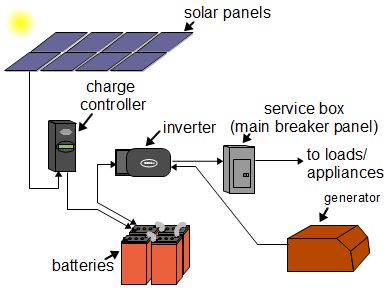
The following is a simplfied diagram of an off-grid system.
Simplified diagram of an off-grid solar power system.
The various parts are:
  • solar panels - These take the solar energy from the sun and turn it into electrical energy, electricity.
  • batteries - Since the sun doesn't always shine, the electrical energy has to be stored somewhere for use in the meantime. We store it in batteries.
  • charge controller - This controls charging of the batteries, similar to how as a cell phone charger controls charging of a cell phone.
  • service box - This part you should be familiar with since you already have one of these. This is your breaker panel with all your breakers in it for in case there is an electrical short somewhere.
  • loads/appliances - Your lights, fridge, fans, clocks, ...
  • generator - A diesel, propane or natural gas generator for generating power in case there hasn't been sun for a long time and the batteries are dead. This will provide elecricity when that happens.
  • inverter - Takes the power in the batteries and converts it into a form suitable for your loads/appliances. It also takes power from the generator and passes some through to your loads/appliances and uses some to charge the batteries.
Photovoltaic/solar panels on a house in an off-grid system.
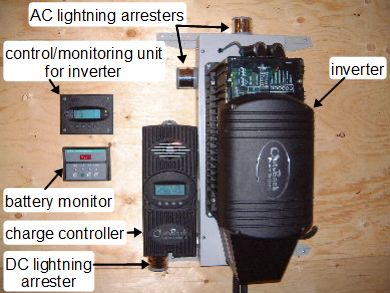
The above are off-grid systems I helped install for Ottawa Solar Power.
Photo including an inverter, charge controller, lightning 
      arresters, and control boxes in an off-grid system.
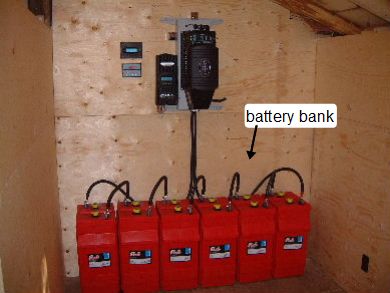
Battery bank with Surrette/Rolls batteries in an off-grid system.
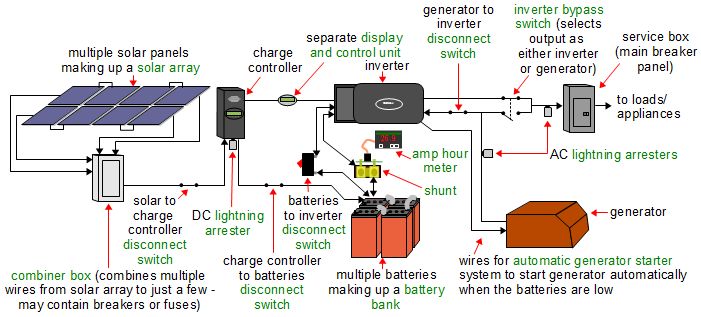
Here's another diagram with more of the parts filled in.
A more complete diagram of an off-grid solar power system.
The added parts are as follows:
  • solar array - If there are multiple solar panels in a system then they're collectively referred to as a solar array.
  • battery bank - Multiple batteries in a system are referred to as a battery bank.
  • disconnect switches - Throughout the system there are switches that are normally closed but are in place in case a part needs to be isolated for repairs and to prevent a short circuit in the system from damaging parts. For example, the charge controller has disconnect switches to either side of it.
  • inverter bypass switch - If the solar system can longer supply power to the loads then this allows the generator to take over while the solar system is repaired.
  • lightning arresters - Lightning arresters are on any wires that may bring damaging electrical current into the system from lightning. For example, if lightning strikes the solar panels then the panels will be damaged but the lightning arrester at the charge controller should protect it.
  • combiner box - Depending on the number of solar panels and how they're wired up, it may make sense to have a box near the panels that combines many of the wires coming from them into just a few wires for the long distance to the charge controller.
  • display and control unit - Some systems allow networking of their components so that they can be controlled and monitored from a single box, usually with an LED display. For example, OutBack's MATE and Magnum Energy's Remote Control.
  • shunt - Part needed if you're going to be using an amp hour meter or battery monitor of some sort. Allows for monitoring of current going into and coming out of the battery bank. See the amp hour meter page for more details.
  • amp hour meter - A device that monitors the battery's state of charge (SOC) by measuring the electrical current going in or out of the battery bank. Also referred to as a battery monitor. See the amp hour meter page for more details.
  • automatic generator starter - If the batteries are low and there is no sun then the generator is run to top up the batteries and take over supplying power to the loads. This can either be done manually or be done automatically as a feature of the inverter, charge controller, display and control unit (e.g. OutBack's products) or a standalone automatic generator starter box (e.g. Magnum Energy's Auto Generator Start Controller.)

Maintaining an off-grid solar power system

And off-grid system is not plug-and-play. The solar panels need to be kept clean, the generator needs to be kept fueled and to have its oil changed periodically, and the batteries needs all sorts of maintenance to keep them working well and to have a long life. See these pages on battery maintenance for details on that.


(Part II) Types of Solar PV mounts


Our previous update listed and explained the different types of roof mounts. This update will explain briefly the types of ground mounts and how effective they can be when it comes to harnessing and making the most profit out of your solar exposure.

Ground Mounts : A ground mounted solar system simply is one that the panels are secured in place by the use of racks and frames or other material and firmly attached to the ground surface. This 'panel system' of arrangement can hold up to 20 panels on a single rack or pole depending on the mount. These structures are designed and built to resist very strong winds and even 50 mph hail stones. 
They usually require a substantial isolated area for the system, for optimum exposure to sunlight, and for security or protection. You wouldn't want your kids playing around one of these - not that they are unstable structures but because like any power generating equipment we want to be safe than sorry.  

There are two main types of ground mounted solar systems, at least for residential and small commercial installs: 

1) Panel Mounted Systems: This system gives the most 'bang on the buck' for a property owner. It's typical in that the panels are attached on racks and secured to a foundation usually made of concrete. Substantial isolated areas as noted above can mean any where from 1 acre to 10,000 acres. These systems make the most out of any available space by maximizing efficiency with electric output.


2) Pole Mounted Systems: This is when the panels on a rack are attached to a pole. The pole is then secured firmly to the ground by insertion into concrete. This mount is mostly used in areas with not so smooth terrains or areas with lots of scrubs or bushes. 


- Tracking Mechanisms: This is were the property owners can be creative. It involves including a tracking mechanism with the ground installation that follows the sun as it moves across the sky. Now remember most solar installs are static, by making the panels follow the sun from sunrise to sunset the system produces the biggest returns especially in net metering.

Ground mounted systems are highly beneficial in that they are easy to maintain. To clean them for example, all you have to do is rinse with water to remove debris and dust or use a plastic shovel to clear snow. When dealing with an engineering issue it becomes very easy for the engineer to move around and examine the system making it easy to spot and work the problem. It also keeps the problem of voiding roof warranties at bay as no connection between the system and the roof is involved.

INDIA’S SOLAR PV: Rays of Hope


With great solar potential, India’s solar mission allows the country to make a long term commitment to controlling carbon emissions, contributing to a greener world, while sustaining economic growth.


Currently, India generates virtually no solar energy. India’s installed solar capacity is estimated to be approximately 3 MW. The Indian government’s recently announced solar initiative, called the ‘National Solar Mission’, envisions the country generating 20 GW of energy from sunlight by 2020. According to the International Energy Agency, global solar capacity is predicted to be just 27 GW by 2020. Therefore, India expects to produce almost three-quarters of the world’s solar energy in approximately 10 years.
With high rates of economic growth and over 15% of the world’s population, India has become a significant consumer of energy resources. However, the South Asian country lacks sufficient domestic energy resources and India imports much of the energy it needs.
To meet its energy requirements, India has announced a vastly ambitious plan to tap the power of the sun to generate clean, renewable electricity.
Currently, India generates virtually no solar energy. India’s installed solar capacity is estimated to be approximately 3 MW. The Indian government’s recently announced solar initiative, called the ‘National Solar Mission’, envisions the country generating 20 GW of energy from sunlight by 2020. According to the International Energy Agency, global solar capacity is predicted to be just 27 GW by 2020.
Therefore, India expects to produce almost three-quarters of the world’s solar energy in approximately 10 years. India’s bold and ambitious solar initiative was approved in principle by the Prime Minister of theRepublic of India, Manmohan Singh, on August 3, 2009. The plan aims not only to cover the country’s daily energy shortfalls (several hours per day), but also to support India’s economic development and its ever growing worries on the climate front. Even though the Indian economy has the second fastest rate of increase in GDP in the world, today 487 million Indians have no electricity. The 20 GW of installed solar capacity would help spark India’s development and help end the energy shortfalls that plague the nation. The sun literally offers several rays of hope for the Indian people.


India’s Energy Sector
India’s ability to produce a reliable supply of solar energy to ensure its energy security will be one of the most important factors in the country’s future development.
India ranks sixth in the world in terms of total energy consumption and the country needs to accelerate the development of its energy sector to meet its growth aspirations. According to India’s Central Electricity Authority, the country’s peak energy demand in 2008 was 120 GW of power, while only 98 GW of power could be supplied.
India is not only experiencing an electricity shortage, but is also increasingly dependent on oil imports to meet its energy demands. In 2006, India was the sixth largest oil consumer in the world. Though rich in coal and abundantly endowed with renewable energy in the form of solar, wind, and hydro, India has only 0.4% of the world’s hydrocarbon reserves. As a net importer of energy, more than 30% of the country’s primary energy needs are met
through import. In the near term, energy imports are expected to rise as India develops and its energy demands increase. In terms of end use, energy demand in the transport sector is expected to be particularly high, as vehicle ownership, particularly of four-wheel vehicles, is forecast to increase rapidly once the global economic crisis abates and domestic spending levels normalize. The average electricity consumption in India is still among the lowest in the world at just 630 kWh per person per year. However, this figure is expected to increase to 1,000 kWh within the next 5 years.
More than half of India’s total electricity consumption is accounted for by coal, followed by oil, which comprises 31% of the country’s total energy consumption. Natural gas and hydroelectric power account for 8% and 6% of consumption, respectively.
Although nuclear power currently comprises a very small percentage of India’s total energy consumption, it is expected to increase due to recent international civil nuclear energy cooperation deals. Solar power is virtually nonexistent and is mainly found in small pockets across India, with scattered, limited use of solar cookers, solar water heaters, solar street lighting and solar lanterns for homes.
However, India has great solar resources. The Indian government reported the country receives 5,000 trillion kWh of energy from the sun, per day. The potential for solar photovoltaic installations in the State of Rajasthan, with its vast area of sunny desert, is unlimited. India has many more States states with great solar potential.
India’s Prime Minister Manmohan Singh said the sun would occupy the “center stage” in the country’s climate strategy and that the success of the country’s solar endeavor would “change the face” of India.
 

Ambitious Solar Plan
India’s ‘National Solar Mission’ aims at expanding the nation’s solar capacity from the current 3 MW to 20 GW by 2020. The solar mission will form the centerpiece of India’s National Climate Change Strategy and will cost an estimated US$20 billion to implement. With worldwide installed solar generation capacity currently totaling just 16.5 GW, the plan has attracted considerable attention for its scale and ambition.
The ‘National Solar Mission’ has a “near term” target of 100 MW and is a three phased plan that hopes to generate 1-1.5 GW of solar power by 2012, 6-7 GW by 2017 and the remainder by 2020. Initially, for the 2009-2012 phase, the plan indicates rapid solar deployment may be achievable through the installation of solar technology on approximately three million square meters of rooftop space on 2,000-3,000 government buildings. Long-term goals of 100 GW by 2030 and 200 GW by 2050 have been established by India’s government.
The country’s solar mission aims to lower the production costs of solar panels and spur domestic manufacturing. Solar funds will be spent on incentives for production, installation and research and development. Once implemented, India’s ‘National Solar Mission’ will ensure large-scale deployment of solar generated power for both grid-connected as well as distributed and decentralized off-grid provisions of commercial energy services. Solar-powered equipment and applications will bemandatory for hospitals, hotels and government buildings. Villages and small towns will be encouraged to participate with micro financing. India will promote solar heating systems and will use 40-50 million square meters of area to install solar collectors in domestic, industrial and commercial sectors. The country’s solar mission also outlines a system of paying households for any surplus power generatedby solar panels that is fed back into the national grid.
The government would also like to provide 3 million households with access to solar lighting by 2012 and install an estimated 20 million solar lights in homes by 2020. The 20 million solar lights could save 1 billion liters of kerosene per year. Solar power could also replace the 20-25 GW of electricity currently generated from diesel that is used to meet peak powers. India’s government believes its ‘National Solar Mission’, in total, could cut about 42 million tons of carbon dioxide emissions. The solar mission is part of India’s overall climate change plan. If the country’s solar energy goals are met by 2020 and the predicted carbon emissions are offset, 100,000 trained specialists may be required to install, manage and maintain the solar infrastructure. The government plans to collaborate with universities that would offer bachelors, masters, and doctorate degrees in solar engineering and solar technology. The government would like to establish solar energy courses at the Indian Institutes of Technology and create a fellowship program to train 100 Indian scientists a year in world-class institutions. An autonomous solar energy authority will be created to execute the solar mission. India’s existing solar energy center near
New Delhi will be upgraded into an ‘apex research institute’ to coordinate solar research centers across the country and promote foreign collaboration.
 

The Road Forward
Foreign collaboration will be crucial to the success of India’s ‘National Solar Mission’ since financial constraints are one of the main problems that India is facing in achieving its established solar energy goals. Currently, India’s domestic solar energy companies do not receive any substantial incentives. There is low demand for solar energy systems within India, which is why the country’s domestic solar companies derive the majority of their revenues from exports.
North Delhi Power Limited, a joint venture between the government and a private company, has proposed a feed-in tariff scheme for India’s capital region. Nonetheless, substantial subsidies will be required to attract home owners to buy solar panels. In addition, the electric grid will have to be engineered and upgraded in order to accept the electricity thousands of homes will feed back into the grid. Pilot projects have been installed to remedy these technical issues but without the adequate financial resources to implement India’s solar mission the plan will never meet its ambitious objectives. Indian government officials are eying international financial help either through bilateral carbon offsetting agreements or those run by the United Nations in order to implement their ambitious plans.
India’s ‘National Solar Mission’ should be one of the main topics of discussion at the Copenhagenclimate talks. The success or failure of India’s solar plan could be largely dependent on the terms of the next international climate treaty. For now, India’s solar mission will be pushed forward by a mixture of policy and regulatory measures. These measures include feed-in tariff programs, making it mandatory for existing thermal power plants to generate at least 5 % of their capacity from solar power and a 10 year tax holiday for solar energy projects. Other solar industry measures include the duty-free import of raw materials and priority bank loans. The government also plans to create a solar fund with an initial investment of US$1.1 billion and to increase the fund by taxing fossil fuels and the power generated from fossil fuels. Indian solar photovoltaic project developers
have taken notice of the policy and regulatory measures. More than 3 GW of solar project proposals have been submitted. Clearly, many developers recognize India’s long term potential with its ever increasing GDP.


India’s ‘National Solar Mission’ is certainly admirable, forward thinking and feasible with the support of not only the Indian government, but also developed countries. International funding will be required along with external technology inputs from the world to implement India’s solar climate mitigation plan and to meet the ambitious renewable energy target’s established by the Indian government. The country’s solar mission allows it to make a long-term commitment to controlling carbon emissions while sustaining economic growth.
International cooperation and shared commitments to meet climate change challenges
can make India’s ‘National Solar Mission’ a reality and will contribute to a greener world.