• Welcomes to Kumbakonam City

    Kumbakonam is one of the oldest towns in Tamilnadu and is famous for its Mahamaham festival. In the 7th Century it was the Capital of Chola Kings. Kumbakonam, the famous temple town of South India, is picturesquely located amidst the two rivers, Cauvery and Arasalar. Read more
  • Shoping at kumbakonam

    Kumbakonam is a Special Grade Municipal Town and second biggest town in terms of administrative status in Thanjavur District. Kumbakonam, being the headquarters of Kumbakonam Taluk, had different names like Kudanthai, Kudamooku and Baskarashetram from time immemorial.. Read more
  • Kumbakonam Temples

    Kumbakonam is known for its temples and mathas (monasteries). There are around 188 Hindu temples within the municipal limits of Kumbakonam... Read more
Showing posts with label Theory. Show all posts

Solar Panel Efficiency Improvement Infographic


While alternative energy like solar panels could revolutionize the way we generate power, they haven’t always been as efficient as they are today. This solar power efficiency infographic shows just how far we’ve come in the earliest days of signs of power conversion. To this day labs are coming up with new solar tech & innovations that are using different materials & chemical solutions to convert more of the sun’s rays into viable electricity that can be put on the grid.

1953 Solar Panel Efficiency

In 1953 when most people weren’t concerned with generating alternative green energy solar panels were showing signs of getting to a point where someone could actually power some household lights. Appliances still weren’t faced with energy compliant saving regulations so most appliances wouldn’t have been able to work off of a 1953 solar panel. The efficiency rating of a solar panel in 1953 was cranking out about 4.5% of the available energy from the sun’s rays into electricity. The amount of electricity generated by a solar panel at that time was about 230 watts.
The catch is that in 1953 the size of the solar panel to generate 230 watts was enormous to today’s standards in size of a typical solar panel width and height. The height of a 4.5% energy conversion solar panel producing 230 watts in 1953 was 213 inches tall and 130 inches wide. That is nearly 3 adults at a height of 6 feet tall in height or exactly 17.75 feet tall. The width of this solar panel was about two shorter adults at 10.83 feet. So you could have 3 adults standing head to toe and two shorter 5′ 5″ adults lying down head to toe. That’s a BIG solar panel!
Cost efficiency for a solar panel that was this big in 1953 in generating electricity came out to about $1,785 a watt. Obviously it makes sense why people weren’t to concerned with installing solar panels at their home in this time frame as it was ridiculously more expensive than getting electricity from the power company off of the power grid.

2012 Solar Panel Efficiency

Let’s jump ahead in time about 59 years to current day technology of solar panels. When this solar efficiency infographic was made in 2012 the conversion rate of taking the sun’s energy and turning it into power was at about 15%. That is more than double the rate we were at in 1953. The sad part is there is still about 85% of the sun’s energy just going to waste.
While the efficiency increased quite a bit from 4.5% to 15% the size of a typical solar panel converting this energy into electricity dropped by more than half. Now the size of  a solar panel producing 230 watts in 2012 is only about 64 inches tall and 39 inches wide. Now if you take an adult and put them next to a solar panel they will most likely be taller than the solar panel standing at 5 feet and 3 inches. If you try to take any adult and lay them down to the width of the solar panel they’re going to be longer than the solar panel that is sitting at only 3 feet and 3 inches now.
With all that size reduction and increase in efficiency of energy to electricity conversion in newer solar panels you save a lot of money too. The typical amount you can expect to shell out in cost for a solar panel by the watt of energy production is $1.30 a watt. That’s more than 1,700 times cheaper than a solar panel in the 1953 time frame. Solar looks to be getting quite a bit cheaper huh?

2015 and Beyond Solar Panel Efficiency

The future of solar panels is looking bright with lab produced technology enhancements getting solar panels to about 23.5% efficiency in energy to electricity conversion. The time period is put at around 2015 – to any time in the future we should be expecting to get a solar panel that can generate energy at a 23.5% efficiency rating. That’s going to save even more money in producing solar electricity for sure.
The size of solar panels is expected to continue getting even smaller too with sizes expected to hit 41 inches tall and 25 inches wide. Toddlers will be able to stand next to solar panels in the future and be quite a bit bigger than them it seems. With a height of 3 feet and 5 inches and a width of around 2 feet and 1 inch you could really fit quite a few of these on a roof nowadays. The future looks bright for solar technology as it progresses in better efficient innovations and reduces the size it takes to put them up. This solar power efficiency improvement infographic really makes it easy to see just how far solar technology has progressed in just 60 years.
Solar Panel Efficiency Improvement Infographic

The evolution of solar power (infographic)


Did you know that today’s photovoltaic cells are based on a lucky finding by Alexandre Becquerel way back in 1839? He placed an electrode in a conductive solution, and when it was hit by sunlight a current was generated. The first solar cell, however, wasn’t produced until 1883, Charles Fritts produced a 1%-efficiency (!) selenium-on-gold photovoltaic panel.
The photovoltaic effect was then followed by the discovery of the photoelectric effect, which Albert Einstein would publish a paper about in 1904. A flurry of photoelectric advances followed, until eventually, in 1954, AT&T Bell Laboratories created the first modern silicon solar cell. Bell Labs also produced the solar cells used in early space satellites like the Vanguard 1. Soyuz 1, in 1967, would also use solar cells, and would become the first manned spacecraft to do so.
Between the 1950s and 70s, solar power fell out of grace. Producing solar cells was still prohibitively expensive ($250 per watt), and their efficiency still hadn’t broken past the 10% mark. As the semiconductor industry flourished, however, and as the size of silicon boulesand the integrated circuit market boomed, the cost of solar panels plummeted. By 1973, solar panels had reached 15% efficiency, and could be produced for around $10 per watt.
Today, the solar power industry is very healthy indeed. The price per watt is down to around $3 and at-home installations (and government subsidies!) are becoming increasingly common — and just take a look at the number of photovoltaic power stations that opened in 2010! Indeed, you have to look no further than President Obama himself to see how popular solar power is becoming: in 2010, he ordered the installation of solar panels and a solar hot water heater at the White House. Now it’s just a matter of when solar power will overtake coal in terms of cost and efficiency, which could occur in the next few years.
For more information on the history of solar technology, check out the infographic below, or read more about the history of solar power on Wikipedia.
The history of solar technology: The Path to ParityInfographic by SunRun – Home Solar Leasing Made Easy

How heat affects photovoltaics


Hoe%20heat%20affects%20PV.jpg
There’s a complex relationship at work between photovoltaics (PV), heat and sunlight. Solar power works best when the sun’s shining (of course). But when the sun’s shining, everything gets hotter.

PV semiconductors offer more resistance in extreme heat, making them less efficient when the modules should be most efficient. Thankfully, this additional resistance is small, at most, reducing efficiency by about 10 percent. But newer technologies—likethin-film PVs, which don’t rely on crystalline silicon to produce electricity—are less susceptible to heat-related efficiency losses.
So despite PV panels being best suited for regions like the southwestern United States, which receive upwards of 6.0 kilowatt hours of sun per square meter daily, PV panels actually function better at colder temperatures, particularly crystalline silicon-based cells, which are the most commonly used. Their thin-film counterparts suffer smaller efficiency losses due to high temperatures. In an arid region like the southwest, most of today’s PV cells aren’t operating at their peak efficiency during the hottest days of the year.
The semiconducting materials used in PVs, particularly in crystalline silicon PV cells, lose efficiency as temperatures increase. The Physics Hypertextbook explained that as temperature in a conducting material increases, quasiparticles, called phonons, are excited and move throughout the material, impeding the uniform movement of electrons. This impedance is what reduces efficiency in PVs when it gets too hot.
Newer technologies like thin-film PV use different semiconductor materials like Copper indium gallium selenide (CIGS), which don’t lose as much efficiency in the heat. In fact, a study by Loughborough University, “Mapping the Performance of PV Modules of Different Types” found that CIGS produced between 0.5 percent to 2.5 percent more power over a year period, “with the largest differences found in hotter climates.” Another form of thin-film PV, using Cadmium Telluride as the semiconducting element to produce electricity, performed better than crystalline or CIGS PV cells did in high temperatures. The study said that “The performance of CdTe is consistently higher than the two other technologies, by a margin of 5-12 percent over c-Si, depending on location.”
However, some new nanophotovoltaics actually capture infrared (heat) radiation from the sun and would feasibly, when they make it to market, operate at higher efficiencies in the heat. Until then, we’re stuck with thin-film PV and silicon PV modules that operate at lower efficiency in higher temperatures.

What is a Kilowatt Hour?


b_250_250_16777215_00_images_g_kilowatthours_250_250.jpg
What is a kilowatt hour?

Different types of energy are measured by different physical units: Barrels or gallons for petroleum, Cubic feet for natural gas, Tons for coal, and Kilowatt-hours for electricity
A kilowatt is a unit of power equal to 1000 watts. Wikpedia defines a watt as a “derived unit of power in the International System of units (SI), named after the 18th century Scottish engineer James Watt.  The unit symbol for a watt is “W” and the unit symbol for a kilowatt is “kW”.
A kilowatt hour is the amount of energy you get from one kilowatt for one hour. Electricity use over time is measured in kilowatt hours . Your electric company measures how much electricity you use in kilowatt hours, abbreviated “kWh”. An example of what one kilowatt-hour can do is: 1200 electric shaves, dry your hair 15 times, 4 TV evenings, use a small refrigerator for 24 hours or 4 evenings of light with 60W incandescent lamps. This according to TreeHugger.com
How many kilowatts does an average U.S.home use?
According to the U.S. Energy Information Administration, in 2008, the average annual electricity consumption for a U.S. residential utility customer was 11,040 kWh, an average of 920 kilowatt hours per month.  Tennessee had the highest annual consumption at 15,624 kWh and Maine the lowest at 6,252 kWh.

3 Types of Residential Solar Electric Power Systems


There are three main types of residential solar electric power systems: grid inter-tied; grid inter-tied with battery backup; and off-grid. These three broad types vary in how closely connected they are to the traditional power utility infrastructure, known as the grid. Each type has strengths that determine how suited they are to your needs.

Grid Inter-Tied Residential Solar Power Systems

A grid inter-tied solar power system is directly connected to the home and to the traditional electric utility grid. Grid inter-tied systems allow the homeowners to get power from either the home electric system or the utility grid. Switching between the residential system and the grid is seamless.
The prime advantage of this type of system is the ability to balance the system production and home power requirements. When a grid inter-tied system is producing more power than the home is consuming, the excess can be sold back to the utility in a practice known asnet metering. When the system is not producing sufficient power, the home can draw power from the utility grid.
Grid inter-tied systems are the lowest cost type of residential solar electric system, due to having fewer required components.

Grid Inter-tied Residential Solar Power System with Battery Backup

A grid inter-tied solar power system is also connected to the traditional utility power grid and adds battery-backup to the system. The addition of a battery backup enables the system to balance production and demand and protects against power outages.
Solar electric system production depends on the available sunlight. When sunlight is abundant, production can exceed demand. When production exceeds demand, the excess power can charge the batteries, which store the electricity. When the system is producing less electricity than demanded by the home, the batteries can make up the shortfall.
Grid Inter-tied systems are also connected to the utility power grid. This enables the homeowners to draw from the grid during periods of excess demand and to sell power to the grid when there is excess production.
While grid inter-tied systems offer more flexibility, they are not without disadvantages. Charging and discharging batteries reduces the overall efficiency of the system and these systems are more complex to design and install and therefore more expensive.

Off Grid Solar Power Systems

An off-grid residential system is completely disconnected from the traditional electric power grid. Without a connection to the utility grid, batteries are essential to balance periods of excess production and excess demand.
To protect against shortfalls of power when the solar system is under-producing and the batteries are discharged, an electric generator is usually added to the system. The generator is used as a power source during periods of prolonged excess production or unusual demand.

All Systems

Within each type of system there are subtle variations in design that effect efficiency and convenience. To determine which system is best for you, review your requirements with a solar installation professional. A professional installer can guide you through the detailed choices of specific systems that best match your needs.

Andhra Pradesh Solar 1000 MW Pre-bid Meeting – Excerpts from Dec 14 Meeting at Hyderabad


Venugopal from EAI consulting team was at the pre-bid meeting that took place last Friday (Dec 14) and the following are what he has to say (this is in regard to the AP solar policy for 1000 MW power purchase that was released recently)
Highlights
1. Lack of clarity – Overall, the policy makers do not appear to have done their homework fully; as a result, there were quite a few questions to which answers were not available or were vague
2.  No payment security mechanism. AP is not TN, but people plonking in 100s of crores are going to expect something more than the utility’s good intentions alone when it comes to payment
3. Benchmark costs – Benchmark costs to be announced AFTER bidding process unlike other states’ policies. CERC CUF will be used as reference. Might not hold good for this state. (I read somewhere that AP is looking at price in the range Rs 6.5-7.5; is this an official estimate or just opinions? – Question from Narsi)
4. Processing fee – Bid processing fee too high@ Rs 2 lakhs as compared to Rs. 10,000 for Rajasthan & Tamil Nadu. Their reasoning of this being done to keep away random applicants does not sound reasonable.
5. No mention of load flow study. (Similar to TN, were there any sub-station capacities mentioned? – Question from Narsi)
Clarifications
1. Whether one company/consortium has to pay Rs 2 lakhs for each bid for processing if they submit multiple bids at different locations.
2. Timelines will be re-examined
Other Comments/Opinions
1.       The team was not prepared well enough. For all its ills, the TN utility appeared to done a much better homework in this connection.
2.       The utility re-iterated that L1 would be the contract PPA price and this would receive top priority over and above any other criteria. So, will it be similar to TN where everyone will be asked to re-bid at L1?
3.       No deemed generation clause which protects loss of revenues to developers in case of grid failure although developer is penalized if plant performs below a benchmark set by the state. Sounds like a double whammy to the developer.
4.       Odisha just announced bid winners with 7.25 being the winning bid. A similar price is expected in AP.
Summary
It appears that AP will have to do a lot of work on its RFS document if it likes to convey to the market that it is taking this seriously. It might help if the state utilities from states keen on solar met up and shared notes. Could result in a far more robust procedures.
I will polish this further during the day. Will be glad to have comments from those who had attended as well as others. You can add your comments below or send me an email – narsi at eai.in

Off-grid solar power systems


        An off-grid solar power system is one that gets most or all of its electricity from the sun using solar panels (photovoltaic panels) and none from a power utility such as a hydroelectric dam, nuclear, coal or natural gas fired plant, ... The grid, which the system is "off" of, refers to the complex network of power lines that connect the utilities to the numerous buildings that use the power. Since in many locations there may be clouds for days or weeks at a time, off-grid systems usually have a back-up generator as well. In addition they may have wind turbines, microhydro and other small electricity generating means.

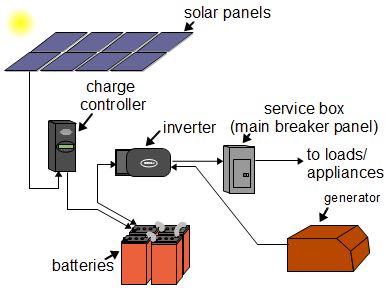
The following is a simplfied diagram of an off-grid system.
Simplified diagram of an off-grid solar power system.
The various parts are:
  • solar panels - These take the solar energy from the sun and turn it into electrical energy, electricity.
  • batteries - Since the sun doesn't always shine, the electrical energy has to be stored somewhere for use in the meantime. We store it in batteries.
  • charge controller - This controls charging of the batteries, similar to how as a cell phone charger controls charging of a cell phone.
  • service box - This part you should be familiar with since you already have one of these. This is your breaker panel with all your breakers in it for in case there is an electrical short somewhere.
  • loads/appliances - Your lights, fridge, fans, clocks, ...
  • generator - A diesel, propane or natural gas generator for generating power in case there hasn't been sun for a long time and the batteries are dead. This will provide elecricity when that happens.
  • inverter - Takes the power in the batteries and converts it into a form suitable for your loads/appliances. It also takes power from the generator and passes some through to your loads/appliances and uses some to charge the batteries.
Photovoltaic/solar panels on a house in an off-grid system.
The above are off-grid systems I helped install for Ottawa Solar Power.
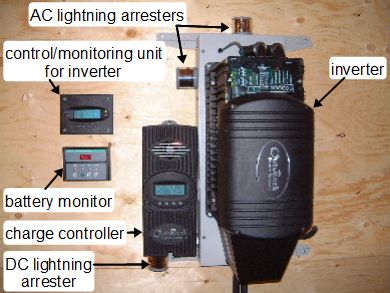
Photo including an inverter, charge controller, lightning 
      arresters, and control boxes in an off-grid system.
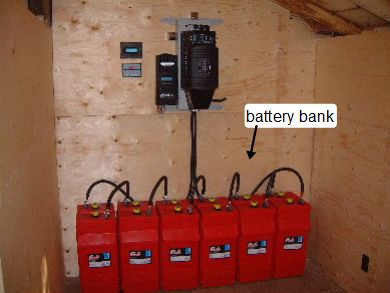
Battery bank with Surrette/Rolls batteries in an off-grid system.
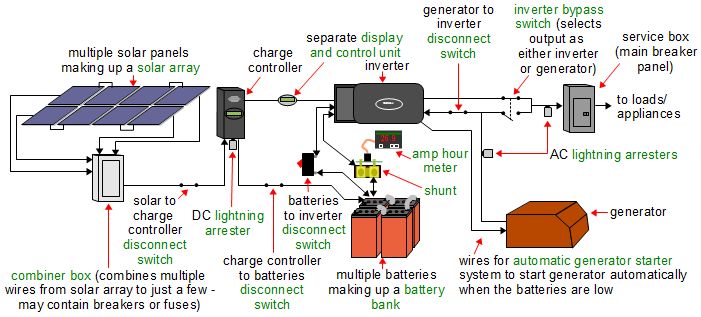
Here's another diagram with more of the parts filled in.
A more complete diagram of an off-grid solar power system.
The added parts are as follows:
  • solar array - If there are multiple solar panels in a system then they're collectively referred to as a solar array.
  • battery bank - Multiple batteries in a system are referred to as a battery bank.
  • disconnect switches - Throughout the system there are switches that are normally closed but are in place in case a part needs to be isolated for repairs and to prevent a short circuit in the system from damaging parts. For example, the charge controller has disconnect switches to either side of it.
  • inverter bypass switch - If the solar system can longer supply power to the loads then this allows the generator to take over while the solar system is repaired.
  • lightning arresters - Lightning arresters are on any wires that may bring damaging electrical current into the system from lightning. For example, if lightning strikes the solar panels then the panels will be damaged but the lightning arrester at the charge controller should protect it.
  • combiner box - Depending on the number of solar panels and how they're wired up, it may make sense to have a box near the panels that combines many of the wires coming from them into just a few wires for the long distance to the charge controller.
  • display and control unit - Some systems allow networking of their components so that they can be controlled and monitored from a single box, usually with an LED display. For example, OutBack's MATE and Magnum Energy's Remote Control.
  • shunt - Part needed if you're going to be using an amp hour meter or battery monitor of some sort. Allows for monitoring of current going into and coming out of the battery bank. See the amp hour meter page for more details.
  • amp hour meter - A device that monitors the battery's state of charge (SOC) by measuring the electrical current going in or out of the battery bank. Also referred to as a battery monitor. See the amp hour meter page for more details.
  • automatic generator starter - If the batteries are low and there is no sun then the generator is run to top up the batteries and take over supplying power to the loads. This can either be done manually or be done automatically as a feature of the inverter, charge controller, display and control unit (e.g. OutBack's products) or a standalone automatic generator starter box (e.g. Magnum Energy's Auto Generator Start Controller.)

Maintaining an off-grid solar power system

And off-grid system is not plug-and-play. The solar panels need to be kept clean, the generator needs to be kept fueled and to have its oil changed periodically, and the batteries needs all sorts of maintenance to keep them working well and to have a long life. See these pages on battery maintenance for details on that.


(Part II) Types of Solar PV mounts


Our previous update listed and explained the different types of roof mounts. This update will explain briefly the types of ground mounts and how effective they can be when it comes to harnessing and making the most profit out of your solar exposure.

Ground Mounts : A ground mounted solar system simply is one that the panels are secured in place by the use of racks and frames or other material and firmly attached to the ground surface. This 'panel system' of arrangement can hold up to 20 panels on a single rack or pole depending on the mount. These structures are designed and built to resist very strong winds and even 50 mph hail stones. 
They usually require a substantial isolated area for the system, for optimum exposure to sunlight, and for security or protection. You wouldn't want your kids playing around one of these - not that they are unstable structures but because like any power generating equipment we want to be safe than sorry.  

There are two main types of ground mounted solar systems, at least for residential and small commercial installs: 

1) Panel Mounted Systems: This system gives the most 'bang on the buck' for a property owner. It's typical in that the panels are attached on racks and secured to a foundation usually made of concrete. Substantial isolated areas as noted above can mean any where from 1 acre to 10,000 acres. These systems make the most out of any available space by maximizing efficiency with electric output.


2) Pole Mounted Systems: This is when the panels on a rack are attached to a pole. The pole is then secured firmly to the ground by insertion into concrete. This mount is mostly used in areas with not so smooth terrains or areas with lots of scrubs or bushes. 


- Tracking Mechanisms: This is were the property owners can be creative. It involves including a tracking mechanism with the ground installation that follows the sun as it moves across the sky. Now remember most solar installs are static, by making the panels follow the sun from sunrise to sunset the system produces the biggest returns especially in net metering.

Ground mounted systems are highly beneficial in that they are easy to maintain. To clean them for example, all you have to do is rinse with water to remove debris and dust or use a plastic shovel to clear snow. When dealing with an engineering issue it becomes very easy for the engineer to move around and examine the system making it easy to spot and work the problem. It also keeps the problem of voiding roof warranties at bay as no connection between the system and the roof is involved.

Types of Residential Solar Electric Power Systems


Depending on the type of residential property or business you own, there is a specific type of Solar Electric system that best suits that location. Whether its located in the heart of a city, in the suburbs, or if its that cabin in the woods - a different type of installation must be used. Location here is the key characteristic as distance from the grid will be determinant in choosing the type of system best for each scenario.


There are basically three types of Solar Electric Systems which are: the Grid Tied Solar Systems, the Grid Tied Solar System with a Battery Back-up or Hybrid Power Generator, and the Off-Grid Solar
Power System. There are other types which are mainly deviations or contain additives on these three main types. The home or business owner together with investigated decisions from the Solar Engineer or Contractor can tweak and make changes to the Electric system as they see fit. Lets take a look at these systems and where they can be installed.
1 - Grid Tied Solar System: This is a very common installation you will find in most areas of the US, and other parts of the world. This system is favorable for cities and suburbs or residential areas with close connections to the electric grid. In this system, the PV installation is connected to the grid and a two way meter may be installed to read the flow of electricity to and from the grid. The advantage with this system is that the PV installation may not necessarily be seized to meet all the needs of the residence or business. If demand surpasses supply at any one time especially in peak hours, electricity is simply pulled from the grid to make up. This situation is reversed when the capacity of the installed system is high enough and produces more then needed electricity. The extra electric power is pushed or back-fed into the grid which produces credits the consumer can then use at periods of low production such as at night to offset their power consumption.

2 - Grid Tied Solar System with Battery Back-up or Hybrid Power Generator: This system can be described as the above system but differs in that it has a battery or power generator component. The system best suits areas without a credible power grid. The Solar engineer may design the system to store some of the electricity produced when production exceeds demand, in specially designed 'Deep Cycle Batteries' for use when the grid goes down. The engineer can also incorporate a fuel electric generator in the design dubbed 'hybrid' for the same function. 

3 -  Off-Grid Solar Power System: This system is completely cut off from the traditional grid. It best suits locations such as cabins in the woods, mountains or remote areas of the developing world with no electric grid. This system also incorporates the battery and the power generator in its design. Instead of using a battery or generator as a simple back-up, it is used as a necessary component. The battery is used to save electricity for rainy days - literarily - while a generator is needed when the battery drains out due to continues use and in days with no power production.

As earlier noted, installing any of these systems depends on your location and recommendation by the Solar engineer or professional. It is important to note that in each design, convenience and efficiency will be affected.

INDIA’S SOLAR PV: Rays of Hope


With great solar potential, India’s solar mission allows the country to make a long term commitment to controlling carbon emissions, contributing to a greener world, while sustaining economic growth.


Currently, India generates virtually no solar energy. India’s installed solar capacity is estimated to be approximately 3 MW. The Indian government’s recently announced solar initiative, called the ‘National Solar Mission’, envisions the country generating 20 GW of energy from sunlight by 2020. According to the International Energy Agency, global solar capacity is predicted to be just 27 GW by 2020. Therefore, India expects to produce almost three-quarters of the world’s solar energy in approximately 10 years.
With high rates of economic growth and over 15% of the world’s population, India has become a significant consumer of energy resources. However, the South Asian country lacks sufficient domestic energy resources and India imports much of the energy it needs.
To meet its energy requirements, India has announced a vastly ambitious plan to tap the power of the sun to generate clean, renewable electricity.
Currently, India generates virtually no solar energy. India’s installed solar capacity is estimated to be approximately 3 MW. The Indian government’s recently announced solar initiative, called the ‘National Solar Mission’, envisions the country generating 20 GW of energy from sunlight by 2020. According to the International Energy Agency, global solar capacity is predicted to be just 27 GW by 2020.
Therefore, India expects to produce almost three-quarters of the world’s solar energy in approximately 10 years. India’s bold and ambitious solar initiative was approved in principle by the Prime Minister of theRepublic of India, Manmohan Singh, on August 3, 2009. The plan aims not only to cover the country’s daily energy shortfalls (several hours per day), but also to support India’s economic development and its ever growing worries on the climate front. Even though the Indian economy has the second fastest rate of increase in GDP in the world, today 487 million Indians have no electricity. The 20 GW of installed solar capacity would help spark India’s development and help end the energy shortfalls that plague the nation. The sun literally offers several rays of hope for the Indian people.


India’s Energy Sector
India’s ability to produce a reliable supply of solar energy to ensure its energy security will be one of the most important factors in the country’s future development.
India ranks sixth in the world in terms of total energy consumption and the country needs to accelerate the development of its energy sector to meet its growth aspirations. According to India’s Central Electricity Authority, the country’s peak energy demand in 2008 was 120 GW of power, while only 98 GW of power could be supplied.
India is not only experiencing an electricity shortage, but is also increasingly dependent on oil imports to meet its energy demands. In 2006, India was the sixth largest oil consumer in the world. Though rich in coal and abundantly endowed with renewable energy in the form of solar, wind, and hydro, India has only 0.4% of the world’s hydrocarbon reserves. As a net importer of energy, more than 30% of the country’s primary energy needs are met
through import. In the near term, energy imports are expected to rise as India develops and its energy demands increase. In terms of end use, energy demand in the transport sector is expected to be particularly high, as vehicle ownership, particularly of four-wheel vehicles, is forecast to increase rapidly once the global economic crisis abates and domestic spending levels normalize. The average electricity consumption in India is still among the lowest in the world at just 630 kWh per person per year. However, this figure is expected to increase to 1,000 kWh within the next 5 years.
More than half of India’s total electricity consumption is accounted for by coal, followed by oil, which comprises 31% of the country’s total energy consumption. Natural gas and hydroelectric power account for 8% and 6% of consumption, respectively.
Although nuclear power currently comprises a very small percentage of India’s total energy consumption, it is expected to increase due to recent international civil nuclear energy cooperation deals. Solar power is virtually nonexistent and is mainly found in small pockets across India, with scattered, limited use of solar cookers, solar water heaters, solar street lighting and solar lanterns for homes.
However, India has great solar resources. The Indian government reported the country receives 5,000 trillion kWh of energy from the sun, per day. The potential for solar photovoltaic installations in the State of Rajasthan, with its vast area of sunny desert, is unlimited. India has many more States states with great solar potential.
India’s Prime Minister Manmohan Singh said the sun would occupy the “center stage” in the country’s climate strategy and that the success of the country’s solar endeavor would “change the face” of India.
 

Ambitious Solar Plan
India’s ‘National Solar Mission’ aims at expanding the nation’s solar capacity from the current 3 MW to 20 GW by 2020. The solar mission will form the centerpiece of India’s National Climate Change Strategy and will cost an estimated US$20 billion to implement. With worldwide installed solar generation capacity currently totaling just 16.5 GW, the plan has attracted considerable attention for its scale and ambition.
The ‘National Solar Mission’ has a “near term” target of 100 MW and is a three phased plan that hopes to generate 1-1.5 GW of solar power by 2012, 6-7 GW by 2017 and the remainder by 2020. Initially, for the 2009-2012 phase, the plan indicates rapid solar deployment may be achievable through the installation of solar technology on approximately three million square meters of rooftop space on 2,000-3,000 government buildings. Long-term goals of 100 GW by 2030 and 200 GW by 2050 have been established by India’s government.
The country’s solar mission aims to lower the production costs of solar panels and spur domestic manufacturing. Solar funds will be spent on incentives for production, installation and research and development. Once implemented, India’s ‘National Solar Mission’ will ensure large-scale deployment of solar generated power for both grid-connected as well as distributed and decentralized off-grid provisions of commercial energy services. Solar-powered equipment and applications will bemandatory for hospitals, hotels and government buildings. Villages and small towns will be encouraged to participate with micro financing. India will promote solar heating systems and will use 40-50 million square meters of area to install solar collectors in domestic, industrial and commercial sectors. The country’s solar mission also outlines a system of paying households for any surplus power generatedby solar panels that is fed back into the national grid.
The government would also like to provide 3 million households with access to solar lighting by 2012 and install an estimated 20 million solar lights in homes by 2020. The 20 million solar lights could save 1 billion liters of kerosene per year. Solar power could also replace the 20-25 GW of electricity currently generated from diesel that is used to meet peak powers. India’s government believes its ‘National Solar Mission’, in total, could cut about 42 million tons of carbon dioxide emissions. The solar mission is part of India’s overall climate change plan. If the country’s solar energy goals are met by 2020 and the predicted carbon emissions are offset, 100,000 trained specialists may be required to install, manage and maintain the solar infrastructure. The government plans to collaborate with universities that would offer bachelors, masters, and doctorate degrees in solar engineering and solar technology. The government would like to establish solar energy courses at the Indian Institutes of Technology and create a fellowship program to train 100 Indian scientists a year in world-class institutions. An autonomous solar energy authority will be created to execute the solar mission. India’s existing solar energy center near
New Delhi will be upgraded into an ‘apex research institute’ to coordinate solar research centers across the country and promote foreign collaboration.
 

The Road Forward
Foreign collaboration will be crucial to the success of India’s ‘National Solar Mission’ since financial constraints are one of the main problems that India is facing in achieving its established solar energy goals. Currently, India’s domestic solar energy companies do not receive any substantial incentives. There is low demand for solar energy systems within India, which is why the country’s domestic solar companies derive the majority of their revenues from exports.
North Delhi Power Limited, a joint venture between the government and a private company, has proposed a feed-in tariff scheme for India’s capital region. Nonetheless, substantial subsidies will be required to attract home owners to buy solar panels. In addition, the electric grid will have to be engineered and upgraded in order to accept the electricity thousands of homes will feed back into the grid. Pilot projects have been installed to remedy these technical issues but without the adequate financial resources to implement India’s solar mission the plan will never meet its ambitious objectives. Indian government officials are eying international financial help either through bilateral carbon offsetting agreements or those run by the United Nations in order to implement their ambitious plans.
India’s ‘National Solar Mission’ should be one of the main topics of discussion at the Copenhagenclimate talks. The success or failure of India’s solar plan could be largely dependent on the terms of the next international climate treaty. For now, India’s solar mission will be pushed forward by a mixture of policy and regulatory measures. These measures include feed-in tariff programs, making it mandatory for existing thermal power plants to generate at least 5 % of their capacity from solar power and a 10 year tax holiday for solar energy projects. Other solar industry measures include the duty-free import of raw materials and priority bank loans. The government also plans to create a solar fund with an initial investment of US$1.1 billion and to increase the fund by taxing fossil fuels and the power generated from fossil fuels. Indian solar photovoltaic project developers
have taken notice of the policy and regulatory measures. More than 3 GW of solar project proposals have been submitted. Clearly, many developers recognize India’s long term potential with its ever increasing GDP.


India’s ‘National Solar Mission’ is certainly admirable, forward thinking and feasible with the support of not only the Indian government, but also developed countries. International funding will be required along with external technology inputs from the world to implement India’s solar climate mitigation plan and to meet the ambitious renewable energy target’s established by the Indian government. The country’s solar mission allows it to make a long-term commitment to controlling carbon emissions while sustaining economic growth.
International cooperation and shared commitments to meet climate change challenges
can make India’s ‘National Solar Mission’ a reality and will contribute to a greener world.


Solar Energy Brings Power to Rural India

                 In Central India, far from the grid of power lines, telephone poles and power transformers an electrical experiment has been taking place. For the last year, the village of Meerwada has been learning to live with solar energy.  Located some 90 minutes from the nearest city by way of a rocky 4×4 dirt road, this small town sits on the cutting edge of a modern-day industrial revolution.
In December 2011, sixty-three homes surrounding Meerwada’s community center were connected to a small solar-panel microgrid that was established by the California-based company SunEdison. The pilot program (later officially named The Eradication of Darkness Plan), selected Meerwada to determine whether small rural villages, such as those found in India’s Guna District, could actually benefit from solar energy. Equally important says Dawn Brister, who serves as SunEdison’s senior manager of marketing communications, was whether the residents would be comfortable with this new change, and what they personally would want to see from the project.
(The) mistake we feel a lot of companies have made when they are trying to take electricity in (to communities) is they don’t take into account how the residents are going to receive it.”
“So we wanted to make sure that the villagers were receptive to it and understood what it could do for them.”
After hearing what the villagers thought of the idea, the engineers then developed a plan that would address the needs of the citizens. The community members were consulted throughout the process to ensure the project would meet their needs. For example, the community center received lighting in and outside the building to allow for comfortable settings for meetings; the privately owned water pump was converted to electrical power from diesel, and a system was set up for other community members to pay for use of the well (rather than walking two miles a day for water); and outside lighting was implemented in areas to allow residents to walk lighted paths and to safely manage livestock after dark.
For much of India, access to electrical power is nothing new. The experience of turning on a lamp to read or cook by at night can be taken for granted as part of 21st century technology.

Solar energy microgrids in Central India

But for some 400 million people in India, electrical power does not exist and has never existed in their homes. Living by the light of day has been a way of life for 28 other villages near Meerwada, where their physical distance from conventional power lines has kept the communities reliant on diesel generators and kerosene lamps.
Meerwada’s success in converting to solar power may change that, says Brister.
“The solar makes perfect sense because of the solar radiance and the meteorological conditions not to mention that they don’t have the grid infrastructure that we have to add to traditional power sources.” The answer, she said, was what was called distributed generation which generates and distributes electricity based on a microgrid, such as the solar power system centralized in Meerwada.
“(A) lot of the people who are without electricity right now are never going to be touched by grid because of the sheer expense and engineering effort that would be required to bring traditional transmission lines out to them,” Brister explains.

The Solar India project

SunEdison has been working to implement solar energy in India since 2010, when the Prime Minister of India, Dr. Manmohan Singh, announced the government’s Solar India project with the bold target of 20,000 MW by 2022, with 3,000 MW by 2017.
 sustainable development Sustainability solar energy solar Renewable Energy renewable electricity clean energy
Recent studies have shown that economic viability in small communities can be tied directly to the quality of one’s living conditions. Improved access to electricity, water and sanitation can have a large impact on residents’ earning capacity, which in turn can play a role in the economic health of a community. It is for this reason that organizations like Water.org and other nonprofits see improved infrastructure and access to water and electricity as essential components in combating poverty in developing nations.

And it’s why SunEdison believes that equipping 29 small communities in Central India with sustainable electricity options will have an impact on India’s own economic wellbeing. Improving the living conditions in small rural communities, Brister says, goes “hand in hand” with improving India’s economic potential as a nation.“For India to be a good business opportunity, it needs to continue to grow economically. Their economy needs to expand, and for their economy to expand, that needs to include all the people in the country. It can’t be just the cities. So (SunEdison has) always seen it as a hand-in-hand effort,” Brister says.  “We want to improve peoples’ quality of life, but we also want to improve their ability to have economic opportunity that is not available to them right now.”Solar power’s potential in rural IndiaFor many of SunEdison’s staff however, bringing solar power to Meerwada’s 400 residents was a more personal endeavor.The people who oversaw the project, says Brister, “could tell you a lot about our technical innovation capability, a lot about our go-to-market strategy, a lot about our product set and our differentiation in the market, but if you ask them why they come to work every day, it’s about helping people get electricity.“Almost everyone on the executive staff has, at some point, been in contact with the people of Meerwada and have seen firsthand what unfettered joy it brings to their life to just be able to turn a light bulb on,” she says, in a village and a geographic area far away from the grid that powers India’s largest cities.And that, Brister points out, is solar energy’s greatest asset.