• Welcomes to Kumbakonam City

    Kumbakonam is one of the oldest towns in Tamilnadu and is famous for its Mahamaham festival. In the 7th Century it was the Capital of Chola Kings. Kumbakonam, the famous temple town of South India, is picturesquely located amidst the two rivers, Cauvery and Arasalar. Read more
  • Shoping at kumbakonam

    Kumbakonam is a Special Grade Municipal Town and second biggest town in terms of administrative status in Thanjavur District. Kumbakonam, being the headquarters of Kumbakonam Taluk, had different names like Kudanthai, Kudamooku and Baskarashetram from time immemorial.. Read more
  • Kumbakonam Temples

    Kumbakonam is known for its temples and mathas (monasteries). There are around 188 Hindu temples within the municipal limits of Kumbakonam... Read more
Showing posts with label History. Show all posts

Solar Trackers Part I - Introduction


The concept of Solar trackers was mentioned briefly when we discussed the types of solar PV - Part II. We said that it involves including a tracking mechanism with the PV installation thatenables it to  follow the sun as it moves across the sky. We also noted that this addition makes the system produce more energy and provide the biggest returns in net metering. The advantages of orienting a solar PV installation Southwards was also discussed, and clearly solar tracking technology builds on this notion - better orientation for optimum performance. 


Flat surface depicts panel
In this update, we will elaborate on this point and dig deeper into the realm of trackers and how they are used in the solar energy industry. A solar tracker as earlier defined is a mechanism that when added to the solar PV system constantly verifies and orients the panels towards the sun. The idea behind using trackers is that solar panels are static while the sun isn't at any time of the day - so trackers are used to help optimize the incidence angle at which the sun's rays reach them. 

The use of solar trackers is occasional for flat PV systems as long as the engineer gets the orientation correct. But on concentrated PV systemssuch as for large commercial energy systems, its paramount to include a tracker. It is oftenadvisable to install the panels in a manner that make the sun's rays reach them at a perpendicular angle or the incidence angle (as shown in the diagram above) should be reduced as much as possible. 

Sparing a lot of tech details we can add that the use of a solar tracker increases the system's output by 50 percent in the summer months and by 20 percent in the winter months. Solar trackers are grouped under two basic categories the single axis trackers and the dual axis trackers. The single tracker rotates east to west following the sun's movement, and the dual trackers include vertical and horizontal movements i.e. they can incline or tilt to account for winter and summer sun angles.

We'll continue the discussion in a Part II by discussing the various tracking techs including the pros and cons of adding trackers to an installed system in our next update.

Types of Solar PV mounts


Our previous update listed and explained the different types of roof mounts. This update will explain briefly the types of ground mounts and how effective they can be when it comes to harnessing and making the most profit out of your solar exposure.

Ground Mounts : A ground mounted solar system simply is one that the panels are secured in place by the use of racks and frames or other material and firmly attached to the ground surface. This 'panel system' of arrangement can hold up to 20 panels on a single rack or pole depending on the mount. These structures are designed and built to resist very strong winds and even 50 mph hail stones. 
They usually require a substantial isolated area for the system, for optimum exposure to sunlight, and for security or protection. You wouldn't want your kids playing around one of these - not that they are unstable structures but because like any power generating equipment we want to be safe than sorry.  

There are two main types of ground mounted solar systems, at least for residential and small commercial installs: 

1) Panel Mounted Systems: This system gives the most 'bang on the buck' for a property owner. It's typical in that the panels are attached on racks and secured to a foundation usually made of concrete. Substantial isolated areas as noted above can mean any where from 1 acre to 10,000 acres. These systems make the most out of any available space by maximizing efficiency with electric output.


2) Pole Mounted Systems: This is when the panels on a rack are attached to a pole. The pole is then secured firmly to the ground by insertion into concrete. This mount is mostly used in areas with not so smooth terrains or areas with lots of scrubs or bushes. 


- Tracking Mechanisms: This is were the property owners can be creative. It involves including a tracking mechanism with the ground installation that follows the sun as it moves across the sky. Now remember most solar installs are static, by making the panels follow the sun from sunrise to sunset the system produces the biggest returns especially in net metering.

Ground mounted systems are highly beneficial in that they are easy to maintain. To clean them for example, all you have to do is rinse with water to remove debris and dust or use a plastic shovel to clear snow. When dealing with an engineering issue it becomes very easy for the engineer to move around and examine the system making it easy to spot and work the problem. It also keeps the problem of voiding roof warranties at bay as no connection between the system and the roof is involved.

Types of Solar Panels


Hyped about being more sustainable and moving into Solar, you decide to do some preliminary homework and learn about Solar Energy and technology before getting started with a sales representative. Your first internet search makes you more inquisitive, and filled with thirst to investigate further. Then you stumble on the different types of Solar Panels. Your questions now become strategically and financially related. Questions such as "which is least expensive?"..."which is most durable or which technology works best in the industry?". Through this blog update we will try to define, explain, and provide some pros and cons to differentiate Solar Panels. Ultimately the decision on which to get and install will depend on you.


Solar Panels constitute a group of interconnected Photovoltaic (PV) cells. Photovoltaics is the direct conversion of light into energy at the atomic level, and PV cells do just this depending on the light incidence and without an external voltage source. PV cells are made up of crystalline silicon that group together to form Solar Modules which further group together to form a PV Array. The larger or wider the array the more light it will capture hence producing more electricity. The type of current they produce is Direct-Current (DC) electricity. 


About 90% of PV cells that exist in the world today constitute a variation of a crystalline silicon base. Some scientists have argued that the main difference between the type of PV cells is the degree of silicon purity in them. This also is a major determinant when it comes to efficiency. You will also read or hear about Solar Panel efficiency which to explain without being too technical is the ability of a said Solar crystal cell to convert a specific percentage of the light received into electricity. Lets look at the different panels:


Mono-Crystalline

Mono-crystalline: These are produced from silicon wafers or single cylindrical crystal of silicon. They are noted for their high silicon content.
Pros: Most efficient panels in the market for both energy and space, they also tend to last longer (>25yrs).
Cons: More expensive, need micro-inverters to prevent circuit shutdown when partially covered by shade, and reduced performance in high temps.


Poly-Crystalline

Poly-crystalline: They are produced from molds of melted and recrystallized silicon. They contain lower silicon content than the mono-crystalline.
Pros: Perform better in high temperatures, cost less to produce -- so customer saves more.
Cons: Less efficient than the mono-crystalline, require more panels for reasonable amount of energy production.


Thin Film
Thin Film or Amorphous:Unlike the other conventional industrial productions, these are not produced from crystalline structures in anyway. They are made of a thin homogeneous layer of silicon atoms attached to a base component or substrate. This base can either be rigid or flexible which increases the possibilities to be creative when installing. Pros: Use less silicon, and relatively less expensive, very flexible and light weight and sustains partial shading.
Cons: Don't last very long, low efficiency (6-12%), occupy more space to produce reasonable energy.


Other types of Solar PV panels are still in research and development, and some are already in the marker in testing phases. We believe this is a very interesting and necessary market as it helps preserve our environment and our future.


Useful Facts on Solar Energy


Solar Energy as we  know is usually measured in kWh (kilo watt hours). To put this in perspective, energy measured at 1 KWh can burn a 100 watt light bulb for up to 10 hrs, and is comparable to burning 170 pounds of coal. Imagine that!!  

Now let's fly back into history and visit Albert Einstein. Albert was instrumental to Solar 
technology for his experiments with solar energy and photovoltaics which landed him the 
1921 Nobel Prize in Physics. Even further back in time; Leonardo da Vinci during his work at the Vatican, would use concave shaped mirrors to heat water. Doesn't that make you think of Solar Hot Water system?

Back to our time and maybe in the near future, we may be able to use Silicon extracted from say a ton of sand and incorporate them into solar panels to produce electricity equal to burning 500,000 ton of coal. Now how about that?!

That said, here are some interestingly 'geeky' facts on Solar Energy:

In full sun, you can safely assume that about 1367 watts (W) reaches each square meter (m2) of the Outer Edge of the Earth's Atmosphere. The Atmosphere absorbs, reflects, and diffuses a portion of the energy, and 1000 W/m2 is the amount of energy that reaches sea level on a clear day at high noon. This condition is for an air mass = 1.5. As the sun follows its path in the sky, the air mass increases and the amount of energy that makes it to a given location is less than 1000 W/m2.

Solar Energy Brings Power to Rural India

                 In Central India, far from the grid of power lines, telephone poles and power transformers an electrical experiment has been taking place. For the last year, the village of Meerwada has been learning to live with solar energy.  Located some 90 minutes from the nearest city by way of a rocky 4×4 dirt road, this small town sits on the cutting edge of a modern-day industrial revolution.
In December 2011, sixty-three homes surrounding Meerwada’s community center were connected to a small solar-panel microgrid that was established by the California-based company SunEdison. The pilot program (later officially named The Eradication of Darkness Plan), selected Meerwada to determine whether small rural villages, such as those found in India’s Guna District, could actually benefit from solar energy. Equally important says Dawn Brister, who serves as SunEdison’s senior manager of marketing communications, was whether the residents would be comfortable with this new change, and what they personally would want to see from the project.
(The) mistake we feel a lot of companies have made when they are trying to take electricity in (to communities) is they don’t take into account how the residents are going to receive it.”
“So we wanted to make sure that the villagers were receptive to it and understood what it could do for them.”
After hearing what the villagers thought of the idea, the engineers then developed a plan that would address the needs of the citizens. The community members were consulted throughout the process to ensure the project would meet their needs. For example, the community center received lighting in and outside the building to allow for comfortable settings for meetings; the privately owned water pump was converted to electrical power from diesel, and a system was set up for other community members to pay for use of the well (rather than walking two miles a day for water); and outside lighting was implemented in areas to allow residents to walk lighted paths and to safely manage livestock after dark.
For much of India, access to electrical power is nothing new. The experience of turning on a lamp to read or cook by at night can be taken for granted as part of 21st century technology.

Solar energy microgrids in Central India

But for some 400 million people in India, electrical power does not exist and has never existed in their homes. Living by the light of day has been a way of life for 28 other villages near Meerwada, where their physical distance from conventional power lines has kept the communities reliant on diesel generators and kerosene lamps.
Meerwada’s success in converting to solar power may change that, says Brister.
“The solar makes perfect sense because of the solar radiance and the meteorological conditions not to mention that they don’t have the grid infrastructure that we have to add to traditional power sources.” The answer, she said, was what was called distributed generation which generates and distributes electricity based on a microgrid, such as the solar power system centralized in Meerwada.
“(A) lot of the people who are without electricity right now are never going to be touched by grid because of the sheer expense and engineering effort that would be required to bring traditional transmission lines out to them,” Brister explains.

The Solar India project

SunEdison has been working to implement solar energy in India since 2010, when the Prime Minister of India, Dr. Manmohan Singh, announced the government’s Solar India project with the bold target of 20,000 MW by 2022, with 3,000 MW by 2017.
 sustainable development Sustainability solar energy solar Renewable Energy renewable electricity clean energy
Recent studies have shown that economic viability in small communities can be tied directly to the quality of one’s living conditions. Improved access to electricity, water and sanitation can have a large impact on residents’ earning capacity, which in turn can play a role in the economic health of a community. It is for this reason that organizations like Water.org and other nonprofits see improved infrastructure and access to water and electricity as essential components in combating poverty in developing nations.

And it’s why SunEdison believes that equipping 29 small communities in Central India with sustainable electricity options will have an impact on India’s own economic wellbeing. Improving the living conditions in small rural communities, Brister says, goes “hand in hand” with improving India’s economic potential as a nation.“For India to be a good business opportunity, it needs to continue to grow economically. Their economy needs to expand, and for their economy to expand, that needs to include all the people in the country. It can’t be just the cities. So (SunEdison has) always seen it as a hand-in-hand effort,” Brister says.  “We want to improve peoples’ quality of life, but we also want to improve their ability to have economic opportunity that is not available to them right now.”Solar power’s potential in rural IndiaFor many of SunEdison’s staff however, bringing solar power to Meerwada’s 400 residents was a more personal endeavor.The people who oversaw the project, says Brister, “could tell you a lot about our technical innovation capability, a lot about our go-to-market strategy, a lot about our product set and our differentiation in the market, but if you ask them why they come to work every day, it’s about helping people get electricity.“Almost everyone on the executive staff has, at some point, been in contact with the people of Meerwada and have seen firsthand what unfettered joy it brings to their life to just be able to turn a light bulb on,” she says, in a village and a geographic area far away from the grid that powers India’s largest cities.And that, Brister points out, is solar energy’s greatest asset.

Solar power project in Maharashtra cleared, says official


Jodhpur: The environment ministry has cleared the way for the world’s largest consolidated solar power project to be located in Dhule, Maharashtra, a top government official said.
A marquee project for the Maharashtra government to advertise its renewable energy commitments, the 125 megawatt (MW) solar plant was among the first large-scale projects by India’s nascent solar sector, which contributes around 1% of the installed power capacity in the country.
“We just got the forest clearance” for the project, said G.J. Girase, director (finance), Maharashtra State Power Generation Co. Ltd. “We expect it to be commissioned by November.”
The project was announced last May, but hit an obstacle in September when state officials in the environment ministry said that a portion of the land meant for it was classified as a “forest”, and thus couldn’t be readily allocated for industrial development.
“We took the matter to (the) Central government. Importantly, this land was completely degraded with no cultivation for several years. Its barrenness was one of the reasons it was chosen as a site for solar development in the first place,” said Girase on the sidelines of the Asia Solar Energy Forum. Mint couldn’t independently confirm this with the environment ministry.
The project, which is a part of a larger 150 MW solar power project at Dhule, is entirely financed by the Maharashtra government, with around 80% of the project cost loaned from German development bank KfW.
The Dhule project is the first of a series of solar projects greater than 100 MW to come up in India. Most of India’s functioning solar power projects generate less than 40 MW each, with only Reliance Power Ltd confirmed to build a 100 MW plant in Rajasthan.
Under the government’s ambitious Jawaharlal Nehru National Solar Mission that started in January 2010, India aims to have 2,000 MW of installed solar power generation capacity by 2013, 10,000 MW by 2017 and 20,000 MW by 2022. Separately, several states have committed to source at least 0.25% of their installed capacity from renewable energy sources, with the Dhule plant also being built to fulfil such obligations.
The successfully commissioning of the plant at Dhule will see another tranche of projects greater than 100 MW each coming up in Maharashtra’s drought-prone Marathwada and Vidarbha regions, said Girase. Other experts said this will pave the way for similar, large initiatives in Rajasthan and Gujarat.
“Rajasthan has far more land suitable for large solar projects and in fact the state government’s thrust is to invite investors—they could be other Indian states or private developers—to establish big solar power projects here,” said Madan Mohan Vijayvergia, director (technical), Rajasthan Renewable Energy Corp. Ltd.
Experts, however, say that while land acquisition and environmental clearances are key issues, the biggest bottlenecks in India’s solar power sector is the infrastructure required to ensure that the solar power generated reaches consumers.
“There may be a lot of interest in solar power. However, investors will come in only when the state utilities have their finances in order. For that there have to be improvements in electricity transmission infrastructure, fair tariff regimes, etc. Not many states in India can boast of that now,” said S. Chander, director general, regional and sustainable development, Asian Development Bank, one of the biggest lenders to India’s renewable energy sector.
Jacob Koshy was a guest of ADB at the Asia Solar Energy Forum in Jodhpur.

SOLAR THERMAL PANELS TO PRODUCE HOT WATER


                   Solar thermal panels are a way of generating hot water from the energy from the sun all year round and even on cloudy days albeit to a lesser extent. It is the most environmentally friendly method of generating hot water, available to almost everyone.
Solar energy is fast becoming the most important energy source for humanity as non-renewable resources such as coal, gas and oil dwindle to nothing. So how does this affordable and green technology work in your home?
How the Solar PV system work
  • Energy from the Sun is ‘harvested’ by the solar thermal panels, either by evacuated tubes or flat plate collectors. The solar energy heats the liquid in the solar thermal panels.
  • The hot liquid from the solar panels is fed into the coil inside the hot water cylinder to heat the water for the home for free.
  • The existing heating system is usually retained to supplement the hot water produced by the solar thermal panels.
  • Most conventional boiler and hot water cylinder systems are suitable for use with solar thermal panel systems but some, such as combination boilers are not.
  • For most properties, the solar thermal panel systems are effective for providing hot water for use in the home, but are not usually large enough to provide hot water for central heating (particularly since central heating is usually required in the winter months when the system is at its least productive).

WHAT ARE SOLAR THERMAL PANELS?

              Solar thermal panels convert solar energy from sunlight into heat energy to provide free hot water to the property. Two types of solar thermal panels are available -
Flat-plate collectors consist of an insulated metal frame with glass on the top and a copper or aluminium absorber plate on the bottom, which is coated with a special dark coating to absorb the sun’s energy.
Sunlight passes through the glass on the top and the sunlight energy is absorbed by and heats up the bottom absorber plate. Fixed to the absorber plate are tubes containing transfer liquid and through thermal conductance the heat from the absorber plate is transferred into the liquid.
Evacuated heat pipe tubes (EHPTs) consist of a number of evacuated glass tubes each of which contains an absorber plate that is fused to a heat pipe. The solar energy is collected in much the same way as a flat-plate collector and is transferred to the transfer liquid. The EHPT panel is contained within an insulated frame. The vacuum surrounding the outside of the heat pipe significantly reduces convection and conduction heat losses to the surrounding air.

Evacuated heat pipe tubes tend to be more efficient than flat-plate collectors, particularly in colder climates.

           Please see our What we Supply section for a detailed look at solar thermal system components we sell and install.

HOW WE INSTALL THE SOLAR THERMAL SYSTEM

               Other than the largest jobs, the great majority of projects take 1 day to install. Please see our Installation section for a step by step guide on how we install these systems reliably and safely.

WILL SOLAR THERMAL SYSTEMS WORK IN MY HOME?

                     Solar thermal panels rely on exposure to solar energy and the more solar energy that is available, the better the system works. Solar thermal panels can be installed on almost any building, whether you are in an urban or rural location. Please see our Is it right for me? section to confirm that your property is suitable.

WILL MY SOLAR THERMAL PANELS WORK WHEN IT’S CLOUDY?

                  Solar thermal panels operate on solar energy, rather than heat, so even if the day seems cool – if there is light, the system will be converting some solar energy into heat. Solar thermal systems will therefore generate heat all year round, but the greatest benefit will be during the summer months.

RELIABILITY OF SOLAR THERMAL SYSTEMS

               The reliability of solar thermal systems has been established through use over many years. Because there are no moving parts, the systems tend to be very reliable and require little maintenance.

HOW DO I GET A SOLAR THERMAL SYSTEM INSTALLED?

               Call or email us, every customer is very important to us, so we'll get back to you as quickly as we can.

Solar Energy Ideas


Solar Energy Ideas thumbnail
Solar energy is a clean, easy-to-use, free renewable source of power.
         In "Solar Energy Projects for the Evil Genius," Gavin Harper describes how energy is used in the developed world, with 58 percent of energy being spent on residential space heating, another 24 percent on heating water and 13 percent on electricity. Solar energy is a clean, easy-to-use, free renewable source of power. You can capture the sun's energy and store it for use when needed, reducing or eliminating reliance on expensive polluting fossil fuels. Does this Spark an idea?


Solar-Powered Fountain

  •                   For a beautiful, energy-efficient water feature in the garden, landscape or backyard, put together a solar-powered fountain. A submersible pump, a small solar array that produces enough energy to power the pump and a decorative fountain are connected for a water display that energy from the sun sustains for free.

Solar Battery Charger

  •                Use the power of the sun to charge your rechargeable batteries, and you won't have to root around in the junk drawer for fresh batteries ever again. Solar battery chargers are available commercially, but you can easily build one with a few simple materials like an AA battery holder, a nine-volt batter clip, a housing with an integral battery holder (optional), eight solar cells and an IN5818 Schottky diode. Hooked up with a simple schematic and positioned to catch the sun's rays, this unit charges batteries, saves money and is a source of free energy.

    Solar Attic Vent Fan

    •           You can install a solar attic vent fan in about a day with simple tools, and you'll save big on your home's summer energy costs, or you'll save year-round if you live in a warm climate. Attics can trap and store a lot of heat, forcing your home's cooling system to work harder and costing you more in electric bills. A solar fan runs on the free energy of the sun to move that hot trapped air out of your attic.

    Sun Room

    • Not only do sun rooms provide some extra living space, but they're a valuable solar energy device. Positioned properly to capture the most sun, even in winter, these rooms capture and store the sun's radiant heat. The best-engineered sun rooms distribute that captured heat to the rest of the house, reducing heating bills and increasing comfort throughout the building.

    Photo-Voltaic System

    •               If you want to make a large-scale investment in your home and in solar energy or if you're building a new home with photo-voltaic technologies, installing a full-scale photo-voltaic system will reap big rewards. Whole-house solar energy systems not only get your electric, water heating and space heating and cooling off the grid, but they can also get you plugged into the grid by allowing you to sell your extra energy to utility companies. That's free energy for your home and some to share with the community, if you're willing and able to invest in the latest solar technologies.


Solar thermal power plants


                           Many people associate solar electricity generation directly with photovoltaics and not with solar thermal power. Yet large, commercial, concentrating solar thermal power plants have been generating electricity at reasonable costs for more than 15 years. Volker Quaschning describes the basics of the most important types of solar thermal power plants.


                      Most techniques for generating electricity from heat need high temperatures to achieve reasonable efficiencies. The output temperatures of non-concentrating solar collectors are limited to temperatures below 200°C. Therefore, concentrating systems must be used to produce higher temperatures. Due to their high costs, lenses and burning glasses are not usually used for large-scale power plants, and more cost-effective alternatives are used, including reflecting concentrators.
\
                 The reflector, which concentrates the sunlight to a focal line or focal point, has a parabolic shape; such a reflector must always be tracked. In general terms, a distinction can be made between one-axis and two-axis tracking: one-axis tracking systems concentrate the sunlight onto an absorber tube in the focal line, while two-axis tracking systems do so onto a relatively small absorber surface near the focal point (see Figure 1).

Concentration of sunlight
FIGURE 1. Concentration of sunlight using (a) parabolic trough collector (b) linear Fresnel collector (c) central receiver system with dish collector and (d) central receiver system with distributed reflectors
                   The theoretical maximum concentration factor is 46,211. It is finite because the sun is not really a point radiation source. The maximum theoretical concentration temperature that can be achieved is the sun’s surface temperature of 5500°C; if the concentration ratio is lower, the maximum achievable temperature decreases. However, real systems do not reach these theoretical maxima. This is because, on the one hand, it is not possible to build an absolutely exact system, and on the other, the technical systems which transport heat to the user also reduce the receiver temperatures. If the heat transfer process stops, though, the receiver can reach critically high temperatures.
 Parabolic Trough Power Plants

Parabolic trough power plants are the only type of solar thermal power plant technology with existing commercial operating systems until 2008. In capacity terms, 354 MWe of electrical power are installed in California, and a plenty of new plants are currently in the planning process in other locations.
The parabolic trough collector consists of large curved mirrors, which concentrate the sunlight by a factor of 80 or more to a focal line. Parallel collectors build up a 300–600 metre long collector row, and a multitude of parallel rows form the solar collector field. The one-axis tracked collectors follow the sun.
The collector field can also be formed from very long rows of parallel Fresnel collectors. In the focal line of these is a metal absorber tube, which is usually embedded in an evacuated glass tube that reduces heat losses. A special high-temperature, resistive selective coating additionally reduces radiation heat losses.
In the Californian systems, thermo oil flows through the absorber tube. This tube heats up the oil to nearly 400°C, and a heat exchanger transfers the heat of the thermal oil to a water steam cycle (also called Rankine cycle). A feedwater pump then puts the water under pressure. Finally, an economizer, vaporizer and superheater together produce superheated steam. This steam expands in a two-stage turbine; between the high-pressure and low-pressure parts of this turbine is a reheater, which heats the steam again. The turbine itself drives an electrical generator that converts the mechanical energy into electrical energy; the condenser behind the turbine condenses the steam back to water, which closes the cycle at the feedwater pump.
It is also possible to produce superheated steam directly using solar collectors. This makes the thermo oil unnecessary, and also reduces costs because the relatively expensive thermo oil and the heat exchangers are no longer needed. However, direct solar steam generation is still in the prototype stage.

 Guaranteed Capacity

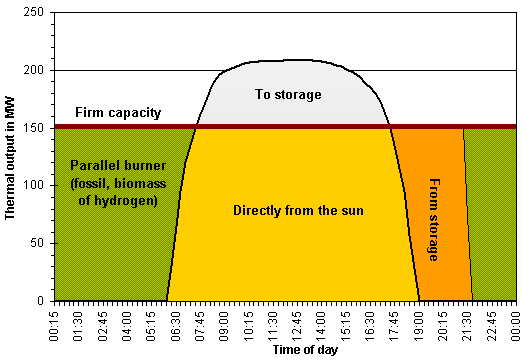
In contrast to photovoltaic systems, solar thermal power plants can guarantee capacity (see Figure 2). During periods of bad weather or during the night, a parallel, fossil fuel burner can produce steam; this parallel burner can also be fired by climate-compatible fuels such as biomass, or hydrogen produced by renewables. With thermal storage, the solar thermal power plant can also generate electricity even if there is no solar energy available.
Typical output of a solar thermal power plant
FIGURE 2. Typical output of a solar thermal power plant with two-hour thermal storage and backup heater to guarantee capacity
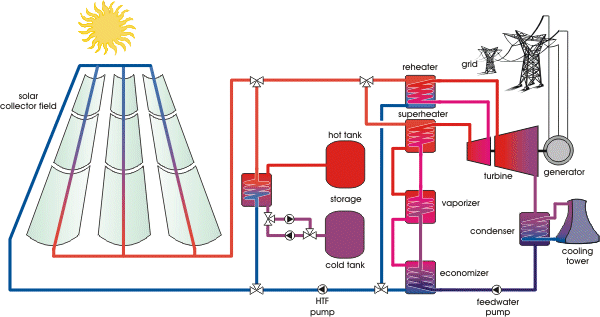
A proven form of storage system operates with two tanks. The storage medium for high-temperature heat storage is molten salt. The excess heat of the solar collector field heats up the molten salt, which is pumped from the cold to the hot tank. If the solar collector field cannot produce enough heat to drive the turbine, the molten salt is pumped back from the hot to the cold tank, and heats up the heat transfer fluid. Figure 3 shows the principle of the parabolic trough power plant with thermal storage.
Solar thermal trough power plant with thermal storage
FIGURE 3. Schematic of a concentrated solar thermal trough power plant with thermal storage
 Trough Power Plant Efficiencies

The efficiency of a solar thermal power plant is the product of the collector efficiency, field efficiency and steam-cycle efficiency. The collector efficiency depends on the angle of incidence of the sunlight and the temperature in the absorber tube, and can reach values up to 75%. Field losses are usually below 10%. Altogether, solar thermal trough power plants can reach annual efficiencies of about 15%; the steam-cycle efficiency of about 35% has the most significant influence. Central receiver systems such as solar thermal tower plants can reach higher temperatures and therefore achieve higher efficiencies.
 Solar Thermal Tower Power Plants

In solar thermal tower power plants, hundreds or even thousands of large two-axis tracked mirrors are installed around a tower. These slightly curved mirrors are also called heliostats; a computer calculates the ideal position for each of these, and a motor drive moves them into the sun. The system must be very precise in order to ensure that sunlight is really focused on the top of the tower. It is here that the absorber is located, and this is heated up to temperatures of 1000°C or more. Hot air or molten salt then transports the heat from the absorber to a steam generator; superheated water steam is produced there, which drives a turbine and electrical generator, as described above for the parabolic trough power plants. Only two types of solar tower concepts will be described here in greater detail.
 Open Volumetric Air Receiver Concept

The first type of solar tower is the open volumetric receiver concept (see Figure 4a). A blower transports ambient air through the receiver, which is heated up by the reflected sunlight. The receiver consists of wire mesh or ceramic or metallic materials in a honeycomb structure, and air is drawn through this and heated up to temperatures between 650°C and 850°C. On the front side, cold, incoming air cools down the receiver surface. Therefore, the volumetric structure produces the highest temperatures inside the receiver material, reducing the heat radiation losses on the receiver surface. Next, the air reaches the heat boiler, where steam is produced. A duct burner and thermal storage can also guarantee capacity with this type of solar thermal power plant.
 Pressurized Air Receiver Concept

The volumetric pressurized receiver concept (see Figure 4b) offers totally new opportunities for solar thermal tower plants. A compressor pressurizes air to about 15 bar; a transparent glass dome covers the receiver and separates the absorber from the environment. Inside the pressurized receiver, the air is heated to temperatures of up to 1100°C, and the hot air drives a gas turbine. This turbine is connected to the compressor and a generator that produces electricity. The waste heat of the gas turbine goes to a heat boiler and in addition to this drives a steam-cycle process. The combined gas and steam turbine process can reach efficiencies of over 50%, whereas the efficiency of a simple steam turbine cycle is only 35%. Therefore, solar system efficiencies of over 20% are possible.
Schematic of two types of solar thermal tower power plant
FIGURE 4. Schematic of two types of solar thermal tower power plant, showing (a) an open volumetric receiver with steam turbine cycle and (b) a pressurized receiver with combined gas and steam turbine cycle
 Comparing Trough and Tower

In contrast to the parabolic trough power plants, no commercial tower power plant exists at present. However, prototype systems – in Almería, Spain, in Barstow, California, US, and in Rehovot, Israel – have proven the functionality of various tower power plant concepts.
The minimum size of parabolic trough and solar tower power plants is in the range of 10 MWe. Below this capacity, installation and O&M costs increase and the system efficiency decreases so much that smaller systems cannot usually operate economically. In terms of costs, the optimal system size is in the range of 50–200 MWe.

 Dish-Stirling Systems

So-called Dish–Stirling systems can be used to generate electricity in the kilowatts range. A parabolic concave mirror (the dish) concentrates sunlight; the two-axis tracked mirror must follow the sun with a high degree of accuracy in order to achieve high efficiencies. In the focus is a receiver which is heated up to 650°C. The absorbed heat drives a Stirling motor, which converts the heat into motive energy and drives a generator to produce electricity. If sufficient sunlight is not available, combustion heat from either fossil fuels or biofuels can also drive the Stirling engine and generate electricity. The system efficiency of Dish–Stirling systems can reach 20% or more. Some Dish–Stirling system prototypes have been successfully tested in a number of countries. However, the electricity generation costs of these systems are much higher than those for trough or tower power plants, and only series production can achieve further significant cost reductions for Dish–Stirling systems.
Dish-Stirling prototype systems in Spain
 Solar Chimney Power Plants

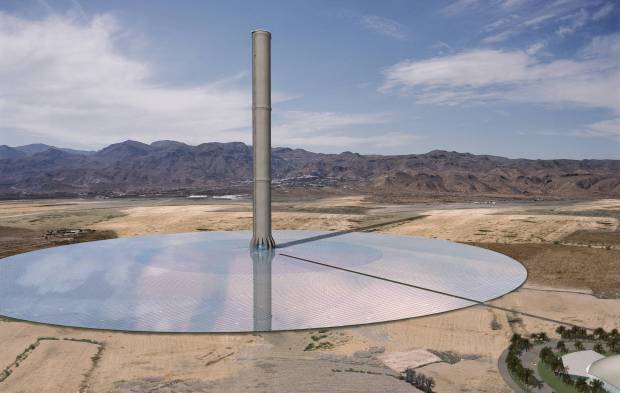
All three technologies described above can only use direct normal irradiance. However, another solar thermal power plant concept – the solar chimney power plant – converts global irradiance into electricity. Since chimneys are often associated negatively with exhaust gases, this concept is also known as the solar power tower plant, although it is totally different from the tower concepts described above. A solar chimney power plant has a high chimney (tower), with a height of up to 1000 metres, and this is surrounded by a large collector roof, up to 130 metres in diameter, that consists of glass or resistive plastic supported on a framework (see artist’s impression). Towards its centre, the roof curves upwards to join the chimney, creating a funnel.
The sun heats up the ground and the air underneath the collector roof, and the heated air follows the upward incline of the roof until it reaches the chimney. There, it flows at high speed through the chimney and drives wind generators at its bottom. The ground under the collector roof behaves as a storage medium, and can even heat up the air for a significant time after sunset. The efficiency of the solar chimney power plant is below 2%, and depends mainly on the height of the tower, and so these power plants can only be constructed on land which is very cheap or free. Such areas are usually situated in desert regions.
However, the whole power plant is not without other uses, as the outer area under the collector roof can also be utilized as a greenhouse for agricultural purposes. As with trough and tower plants, the minimum economical size of solar chimney power plants is also in the multi-megawatt range.

5 MW solar chimney power plant
Artist’s impression of a 5 MW solar chimney power plant SCHLAICH BERGERMANN SOLAR (SBS) GMBH, STUTTGART www.sbp.de
 Electricity Generation Costs

Due to the poor part-load behaviour of solar thermal power, plants should be installed in regions with a minimum of around 2000 full-load hours. This is the case in regions with a direct normal irradiance of more than 2000 kWh/m2 or a global irradiance of more than 1800 kWh/m2. These irradiance values can be found in the earth’s sunbelt; however, thermal storage can increase the number of full-load hours significantly.
The specific system costs are between €2000/kW and €5000/kW depending on the system size, system concept and storage size. Hence, a 50 MWe solar thermal power plant will cost €100–250 million. At very good sites, today’s solar thermal power plants can generate electricity in the range of €0.15/kWh, and series production could soon bring down these costs below €0.10/kWh.
The potential for solar thermal power plants is enormous: for instance, about 1% of the area of the Sahara desert covered with solar thermal power plants would theoretically be sufficient to meet the entire global electricity demand. Therefore, solar thermal power systems will hopefully play an important role in the world’s future electricity supply.